
North Carolina Flag Status — Is the Flag at Half-Staff Today?
The current status could not be loaded just now. The national status is on the main flag page.
Who lowers the flag in North Carolina
In North Carolina, flag status is administered by the Department of Administration, which maintains the official record of half-staff orders. Orders come from the Governor, but it is the Department that publishes and archives them — so the departmental page, not a press release, is the authoritative source.
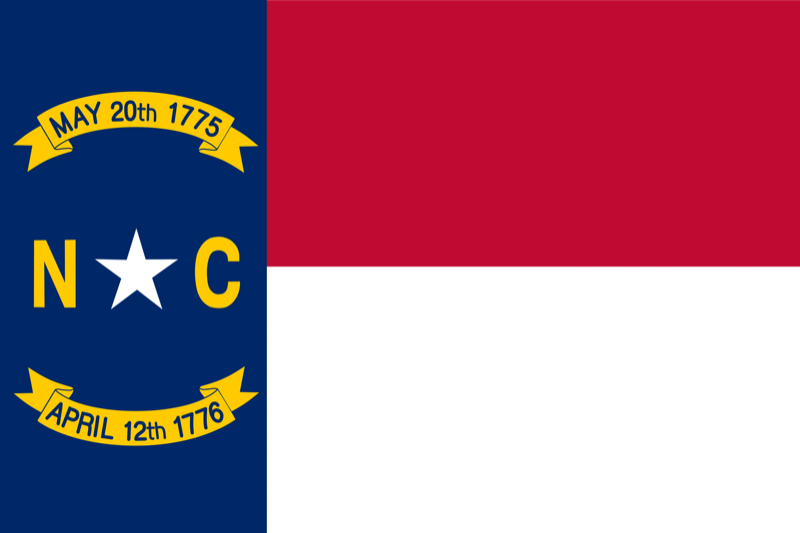
The flag of North Carolina
A blue vertical hoist bears a white star between gold letters “N” and “C,” along with two scrolls: one dated May 20, 1775 (the disputed Mecklenburg Declaration) and one dated April 12, 1776 (the Halifax Resolves authorizing independence).
North Carolina on the American flag
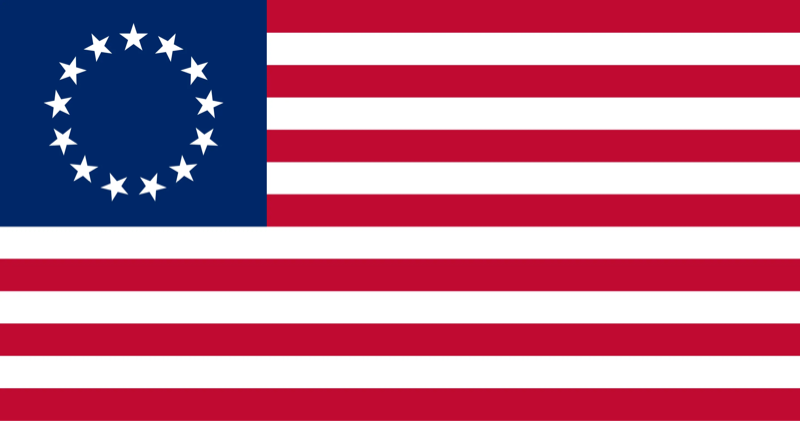
Adopted by the Flag Resolution of June 14, 1777 — 'Resolved, that the flag of the thirteen United States be thirteen stripes, alternate red and white; that the union be thirteen stars, white in a blue field, representing a new constellation.' The circular star arrangement is traditionally credited to Betsy Ross, the Philadelphia upholsterer said to have sewn the first example for General Washington.
Sunrise and sunset in Raleigh
The flag is raised at sunrise and lowered at sunset. Today at the state capital:
How North Carolina became a state
Split from the Province of Carolina in 1712, North Carolina was the site of the first attempted English colony at Roanoke in 1587. The state initially refused to ratify the U.S. Constitution without a Bill of Rights, finally joining the Union on November 21, 1789 — about two months after Congress sent the Bill of Rights to the states.
Admitted November 21, 1789 — the 12th state.
North Carolina at a glance
Did you know
- North Carolina is the nation’s largest producer of sweet potatoes.
- The Biltmore Estate in Asheville is the largest privately owned home in America.
- Babe Ruth hit his first professional home run in Fayetteville in 1914.
- The Outer Banks were a notorious haunt for the pirate Blackbeard.
Born or raised here: James K. Polk (11th President; Mecklenburg County) · Andrew Johnson (17th President; Raleigh) · Michael Jordan (basketball legend; raised in Wilmington) · Maya Angelou (poet, longtime resident) · Billy Graham (evangelist; Charlotte) · Nina Simone (singer; Tryon)
North Carolina in the American Record
Moments from the daily edition that happened in North Carolina.
Official source
Orders are announced by the Governor’s office.
Common questions.
Is the flag at half-staff in North Carolina today?+
The status above answers that for today. A national half-staff order applies in North Carolina as it does everywhere else; the Governor can also lower flags within the state independently.
Who orders flags to half-staff in North Carolina?+
In North Carolina, flag status is administered by the Department of Administration, which maintains the official record of half-staff orders. Orders come from the Governor, but it is the Department that publishes and archives them — so the departmental page, not a press release, is the authoritative source.
Does a county order mean the whole of North Carolina lowers its flags?+
No. A county or single-facility order (the State Capitol, for instance) applies only where it says it does. This page shows those separately from the statewide status precisely so the two are never confused — if the status above reads full-staff, North Carolina has no statewide order in effect regardless of any local one.
When should the flag be raised and lowered in North Carolina?+
The flag flies from sunrise to sunset. Today at the state capital, Raleigh, those times are shown above. On the final day of a half-staff order that runs "until sunset", the flag returns to full height at the local sunset — which is why the West Coast stays lowered a few hours after the East.
Flag status for every state, and the day in American history — one page, every morning.
See the full board →