Reading 3 of 9 free1776 Club · all 9 storiesSunday, June 14
From the desk
Take a moment to reflect on the adoption of our national flag, the Stars and Stripes, by the Second Continental Congress on this day in 1777. It's a fascinating look at how even in the midst of uncertainty and conflict, symbols of unity and identity were being forged. Also, don't miss the tale of the Bear Flag Revolt in 1846—a dramatic episode that, while brief, captures the spirit of independence and adventure that shaped our nation.
— The Patriot Compass desk
1777Featured · This day in history
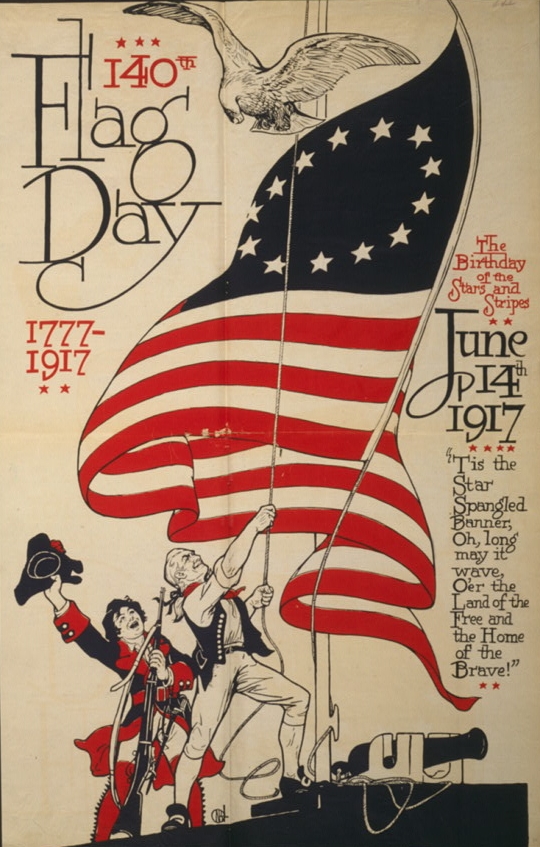
Congress Adopts the Stars and Stripes, June 14, 1777
Two years into a war with no guaranteed outcome, the Second Continental Congress paused long enough to define what its armies were fighting under. On June 14, 1777, meeting in Philadelphia, the Congress passed the Flag Resolution: thirteen stripes, alternate red and white, with thirteen stars on a blue field — "representing a new constellation." The resolution named no designer, specified no arrangement of the stars, and gave no guidance on which stripe color came first. It was less a grand proclamation than a brief administrative order, and it has outlasted nearly everything else that Congress ever produced.
The Flag Resolution of June 14, 1777 launched a design that has been revised officially twenty-six times — most recently in 1960, when Hawaii's admission required a new arrangement drawn by a seventeen-year-old Ohio student. The fifty-star flag has now flown longer than any previous version, outlasting the original thirteen-star design by more than a century. What began as a naval identification tool became the most recognized national symbol in American life.
Did you know
QWho is the most credible candidate for designing the original Stars and Stripes — and why did Congress refuse to pay him?
Francis Hopkinson of New Jersey — a signer of the Declaration of Independence and chairman of the Continental Navy Board's Middle Department — submitted a detailed invoice to Congress in May 1780 requesting payment for designing the U.S. flag and several other government devices. Congress rejected his claim on the grounds that he had not been the sole designer and that he already received a government salary. The dispute was never resolved, and Hopkinson died in 1791 with the question still open. His name rarely appears in popular accounts of the flag's origin, largely because the Betsy Ross legend, which emerged in the 1870s, crowded out the documentary record.
QWhat did the soldiers at Fort Stanwix use to make the first Stars and Stripes flown in battle?
When British and Loyalist forces besieged Fort Stanwix in upstate New York on August 3, 1777, the garrison had no official flag. Soldiers assembled one from materials scavenged inside the fort: white shirts were cut into white stripes, red flannel petticoats provided the red stripes, and a blue coat was fashioned into the star field. The improvised flag flew over the fort throughout the siege — the first documented instance of the Stars and Stripes in combat. The gap between the Flag Resolution's passage on June 14 and this first battlefield appearance was less than seven weeks.
QHow vague was the original Flag Resolution — and what did that vagueness cost later flag makers?
The Flag Resolution of June 14, 1777 ran to a single sentence. It specified thirteen alternating red-and-white stripes and thirteen white stars on a blue field but gave no instruction on the arrangement of the stars, the number of points on each star, the orientation of the flag, or even which stripe color — red or white — appeared at the top. Early flags varied considerably as a result: some had stars in rows, others in circles, some with six-pointed stars, others with five. It was not until the early nineteenth century that any standardization took hold, and even then, it was informal. Congress did not mandate a specific star arrangement until 1912.
The Daily Record · free by email
Tomorrow's edition in your inbox — one story, one quote, the flag.
1775military
The Continental Army Is Established by the Second Continental Congress
Less than two months after the first shots at Lexington and Concord, the colonies had militiamen in the field but no unified command — a patchwork of local forces with no shared structure, no common supply, and no clear authority over any of it. The Second Continental Congress resolved that on June 14, 1775, establishing the Continental Army to coordinate the fight against Britain across all thirteen colonies. The following day, Congress unanimously appointed George Washington of Virginia as commander-in-chief. He would hold that commission for eight years, until he stood before Congress in December 1783 and handed it back.
June 14 is now observed as the United States Army Birthday — a direct institutional line from that 1775 resolution to the force that exists today. The Continental Army's founding also set the template for American civil-military relations: Congress created the army, appointed its commander, and ultimately received his commission back. Washington's voluntary surrender of power in 1783 became one of the most cited acts in American political memory, held up from the Constitutional Convention onward as proof that republican government could survive a victorious general.
Did you know
QWhy did George Washington ask his officers to wear colored feathers in their hats?
In 1775 the Continental Army had no uniforms at all — none. Washington, unable to outfit his men, issued a general order asking officers to wear cockades of specific colors so that soldiers could identify rank by sight: red or pink for field officers, yellow or buff for captains, green for subalterns. It was a workaround born of near-total material scarcity, and it applied to an army fighting a professional European force with standardized kit. The order is one of the more quietly astonishing documents of the early war — a reminder that the institution whose founding is commemorated every June 14 began, practically speaking, with hat decorations.
QHow did a Prussian officer reshape the Continental Army in a single winter?
Baron Friedrich Wilhelm von Steuben arrived at Valley Forge in February 1778 with no formal commission, a limited command of English, and a set of Prussian Army drill manuals he would adapt on the fly. He began by personally training a model company of 100 soldiers, then sent those men out as instructors to the rest of the army. By spring, Washington had an infantry force that could maneuver in formation, fix bayonets on command, and hold a line under fire. Von Steuben stayed on as Inspector General through 1784 — outlasting the war itself — and his Regulations for the Order and Discipline of the Troops of the United States became the Army's standard drill manual for decades.
QWhat did the Continental Army's racial composition look like, and why does the number matter?
Approximately 6,600 people of color served with colonial forces during the Revolutionary War — a figure that makes the Continental Army one of the most integrated military forces in the eighteenth-century Atlantic world. The number matters partly because of what was happening simultaneously: in November 1775, Virginia's royal governor Lord Dunmore issued a proclamation promising freedom to any enslaved person who escaped a Patriot master and took up arms for the Crown. The Continental Army and the British Army were, in effect, competing for the same population. That both forces made use of Black soldiers — under radically different terms and promises — is one of the sharper contradictions running through the founding military of a republic that would not resolve the question for another eighty years.
1846military
The Bear Flag Rises Over Sonoma: California's One-Month Republic
By the spring of 1846, American settlers in California's Sonoma Valley had been barred from buying land, threatened with expulsion, and were hearing rumors of a Mexican military force marching their way. Before dawn on June 14, thirty-three armed immigrants surrounded the plaza at Sonoma, seized 170 government-owned horses, and took General Mariano Guadalupe Vallejo — the man who had built the town — prisoner in his own home. Within days, a hand-sewn flag bearing a grizzly bear and a lone star flew over the Sonoma Barracks, and the California Republic was declared. It lasted twenty-five days.
The Bear Flag Republic was the first act of the American Conquest of California, and its homemade flag outlasted the conquest itself — the grizzly-and-star design became the basis for California's official state flag, still flying today. The revolt also set the legal template for the land-title disputes that would tie up Sonoma's courts for decades and reshape how the federal government handled property claims in all future western territories.
Did you know
QWhat happened to Vallejo after the rebels arrested him and rode him to Frémont's camp?
Vallejo was held at Frémont's Sutter's Fort camp for roughly two months, despite having shown the rebels hospitality and attempted to negotiate with them peacefully. The irony was considerable: Vallejo was arguably more sympathetic to American settlement than most Mexican officials, and had spent years building Sonoma into a prosperous town. His imprisonment ended when U.S. forces formally took control of California. He never fully recovered his influence, and the conquest he had been willing to accommodate stripped away much of the land and standing he had spent his life accumulating.
QHow did a teenager's art critique end up preserved in the historical record of the Bear Flag?
The bear painted on the original Bear Flag drew immediate mockery. John E. Montgomery, son of U.S. Navy Commander John B. Montgomery, recorded the assessment that the painted grizzly looked like 'Cuffy came down growling' — Cuffy being a common name for a bear at the time, suggesting the animal looked more shambling and domestic than ferocious. The original flag was eventually destroyed in the fires following the 1906 San Francisco earthquake, leaving only written descriptions and later reproductions to carry the image forward.
QWhy did the rebels seize horses before they seized Sonoma's plaza — and whose horses were they?
The 170 horses taken in the pre-dawn raid on June 14 were Mexican government property being moved by soldiers — military stock, not civilian animals. Seizing them before storming Sonoma served two purposes: it denied Mexican forces a means of rapid response, and it gave the small rebel band a logistical asset they badly needed. Thirty-three men taking a garrisoned town required some advantage; arriving on foot against mounted opposition would have been a different calculation entirely. The horse seizure was likely the most tactically decisive act of the entire revolt.