Reading 3 of 6 free1776 Club · all 6 storiesMonday, July 20
From the desk
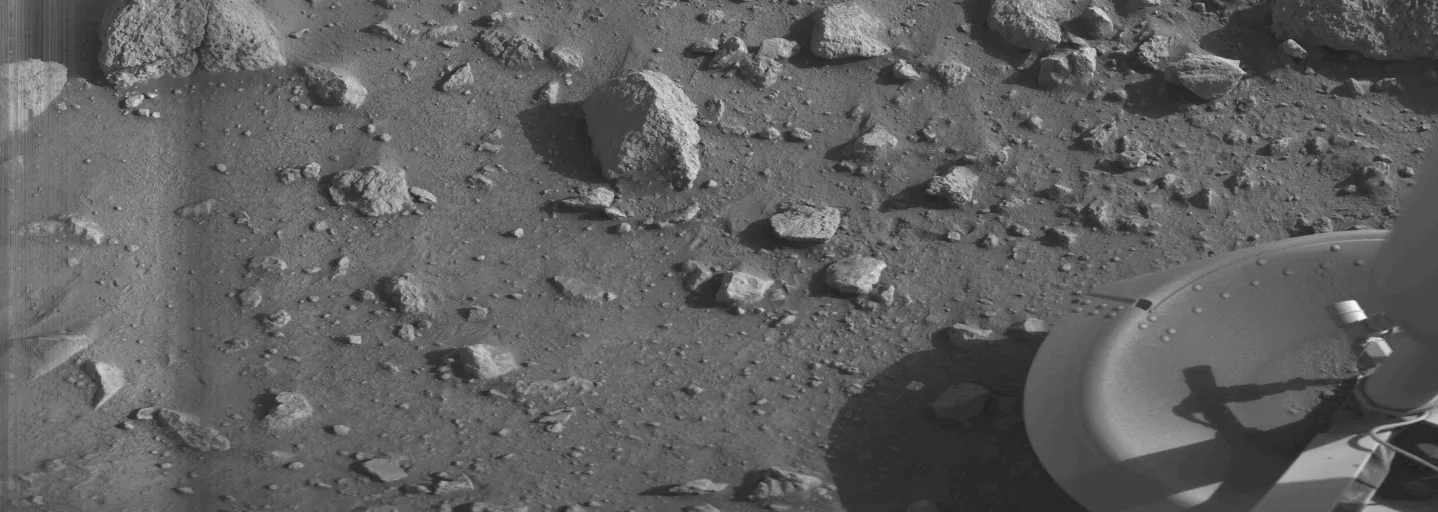
Start with 1969. Neil Armstrong brought the Eagle down through alarms he'd never trained for, and landed with about 50 seconds of fuel left. Worth a longer look: seven years later to the day, Viking 1 dropped through a parachute-and-retrorocket sequence no one had ever tried on Mars and sent back a photograph within minutes of touching down. The Navy's Polaris test off Florida in 1960 rounds out a date NASA and the Pentagon both claimed early.
— The Patriot Compass desk
1969Featured · This day in history
Eagle Lands on the Moon
For eight years, since John F. Kennedy set the goal before Congress, America had been racing the Soviet Union to the Moon. On July 20, 1969, the Lunar Module Eagle, carrying Neil Armstrong and Buzz Aldrin, descended toward the Sea of Tranquility while unexpected 1201 and 1202 computer alarms sounded and fuel ran dangerously low. At 20:17:40 UTC, Armstrong radioed Mission Control that the Eagle had landed, with roughly 50 seconds of fuel to spare. Six and a half hours later, he stepped onto the surface as the first human to walk on another world.
Kennedy's 1961 pledge to land a man on the Moon "before this decade is out" became the measuring stick for American technological ambition for a generation. Apollo 11 answered a Soviet head start in space with an achievement no other nation has matched: American boots on lunar soil, an American flag planted in gray dust, and a command module now preserved at the Smithsonian as a national relic.
Did you know
QWhat did the lunar samples reveal that nobody expected?
The 47.5 pounds of rock and dust Armstrong and Aldrin collected turned out to contain three minerals never before identified on Earth or anywhere else. Scientists studying the Sea of Tranquility samples had to name new material categories to describe what the astronauts had scooped into their collection bags. The Moon, it turned out, had been quietly cooking chemistry no laboratory on Earth had ever produced.
QWhat did Buzz Aldrin do alone in the Lunar Module that never made the broadcast?
Before stepping outside, Aldrin privately took communion inside the cramped cabin of the Eagle, using a kit given to him by his Presbyterian church back home. He said nothing about it over the open radio channel at the time. It stands as the only religious ceremony ever performed on the surface of another world, conducted in near-total silence while Armstrong worked nearby.
QWhy did Mission Control think Eagle had more fuel than it actually did?
A low-fuel warning light came on during Armstrong's manual dodge around the boulder field, and the reading it gave controllers in Houston did not match reality. Only after the mission did engineers recalculate the true figure: roughly 216 pounds of usable propellant, good for about 45 to 50 seconds of burn. Everyone in the room that night was working from a number that was wrong.
The Daily Record · free by email
Tomorrow's edition in your inbox — one story, one quote, the flag.
1960military
USS George Washington Fires Two Polaris Missiles from Beneath the Atlantic
The Navy had spent three years developing a way to put nuclear missiles somewhere no enemy could find them. On July 20, 1960, the USS George Washington, cruising submerged off the Atlantic Missile Test Range near Florida, fired a Polaris missile that arced toward the Atlantic Missile Test Range's impact area. Less than two hours later, a second missile followed, striking the impact area 1,100 nautical miles downrange. Commander James Osborn's crew radioed President Eisenhower the message: "Polaris — from out of the deep to target. Perfect."
Eisenhower got word of a weapon Moscow could not preempt with a first strike. The Polaris submarine gave the United States its first survivable nuclear deterrent, a platform that could ride out an attack and still retaliate, which changed how planners on both sides thought about striking first.
Did you know
QHow many missiles could George Washington actually carry into a Cold War patrol?
Sixteen. That number came directly from the 130-foot hull section grafted into the boat, and it became the template for the class: George Washington's sister ship, Patrick Henry, was armed with the same sixteen missiles once Polaris went operational in late 1960. Sixteen tubes per boat became a standard the Navy would carry into later missile submarine classes for decades, long after Polaris itself gave way to newer missiles.
QWho rode along on the launch instead of waiting for a report back at headquarters?
Rear Admiral William Raborn, the officer who had run the Polaris development program from its start, was aboard George Washington as an observer for the July 20 launch. He had spent four years pushing the submerged-launch concept from theory to hardware, and he chose to be in the boat rather than ashore when it either proved out or failed. The gamble paid off twice that afternoon, first at 1:39 p.m. and again at 4:32 p.m.
QHow far did George Washington travel in the years after that first launch?
By 1970, a decade after leaving Groton, Connecticut, George Washington pulled into Charleston, South Carolina, to refuel after logging roughly 100,000 nautical miles at sea. She kept going for another decade and a half after that, finishing her career with fifty-five deterrent patrols split between the Atlantic and Pacific fleets over twenty-five years of service, a workload the July 1960 test was built to make possible.
1864military
Hood Attacks Thomas at Peachtree Creek, Fails to Break Union Line
By July 1864, Sherman's armies had pushed to within sight of Atlanta, with Peachtree Creek the last natural barrier before the city. John Bell Hood, who had replaced Joseph E. Johnston as Confederate commander only two days earlier, tried to strike Maj. Gen. George Thomas's Army of the Cumberland while it was still crossing the creek. Confusion between Hood and Lt. Gen. William Hardee delayed the attack until four in the afternoon, giving Union troops time to dig in. The Confederates broke through in one spot but could not hold it, and by the end of the day Thomas's line had bent without breaking.
Peachtree Creek, Fulton County, GeorgiaStory page →
The American Throughline
Peachtree Creek was Hood's best chance to stop Sherman before Atlanta fell, and its failure set up the city's capture on September 1, 1864, which broke the Confederacy's last hope for a negotiated peace before that fall's election. Lincoln's reelection, and with it the war's outcome, turned in part on the six weeks of fighting this battle opened.
Did you know
QWhat did Stewart's Confederate divisions actually capture on the Union side of the line?
On the Confederate left flank, Alexander Stewart's attack broke through further than anywhere else along the line that afternoon. His men forced two Union brigades to fall back and overran most of the 33rd New Jersey Infantry Regiment, seizing the unit's battle flag along with a four-gun Union artillery battery. It was the single clearest tactical success the Confederates managed all day, and it happened on the flank Hood was not personally overseeing when the fighting peaked.
QWhy was Patrick Cleburne's division sitting out the attack that afternoon?
Cleburne, one of the most respected division commanders in the Army of Tennessee, had been held back as a reserve force rather than committed to the initial assault. Once the attack stalled and Cheatham's corps came under heavy Union artillery fire on Thomas's left, Hood's staff redirected Cleburne's men to reinforce Cheatham instead of using them to widen Stewart's breakthrough on the opposite flank. The reserve that might have exploited Stewart's gains never got the chance.
QHow unfinished were the Union defenses when the Confederates finally attacked?
Thomas's Army of the Cumberland had only partially completed its defensive earthworks along Peachtree Creek by four o'clock, when the delayed Confederate assault finally arrived. The three extra hours bought by the confusion between Hood and Hardee gave Union engineers and infantry just enough time to get partial works in the ground, works that were incomplete but still sturdy enough to help absorb repeated Confederate charges without collapsing.