Reading 3 of 10 free1776 Club · all 10 storiesFriday, July 24
From the desk
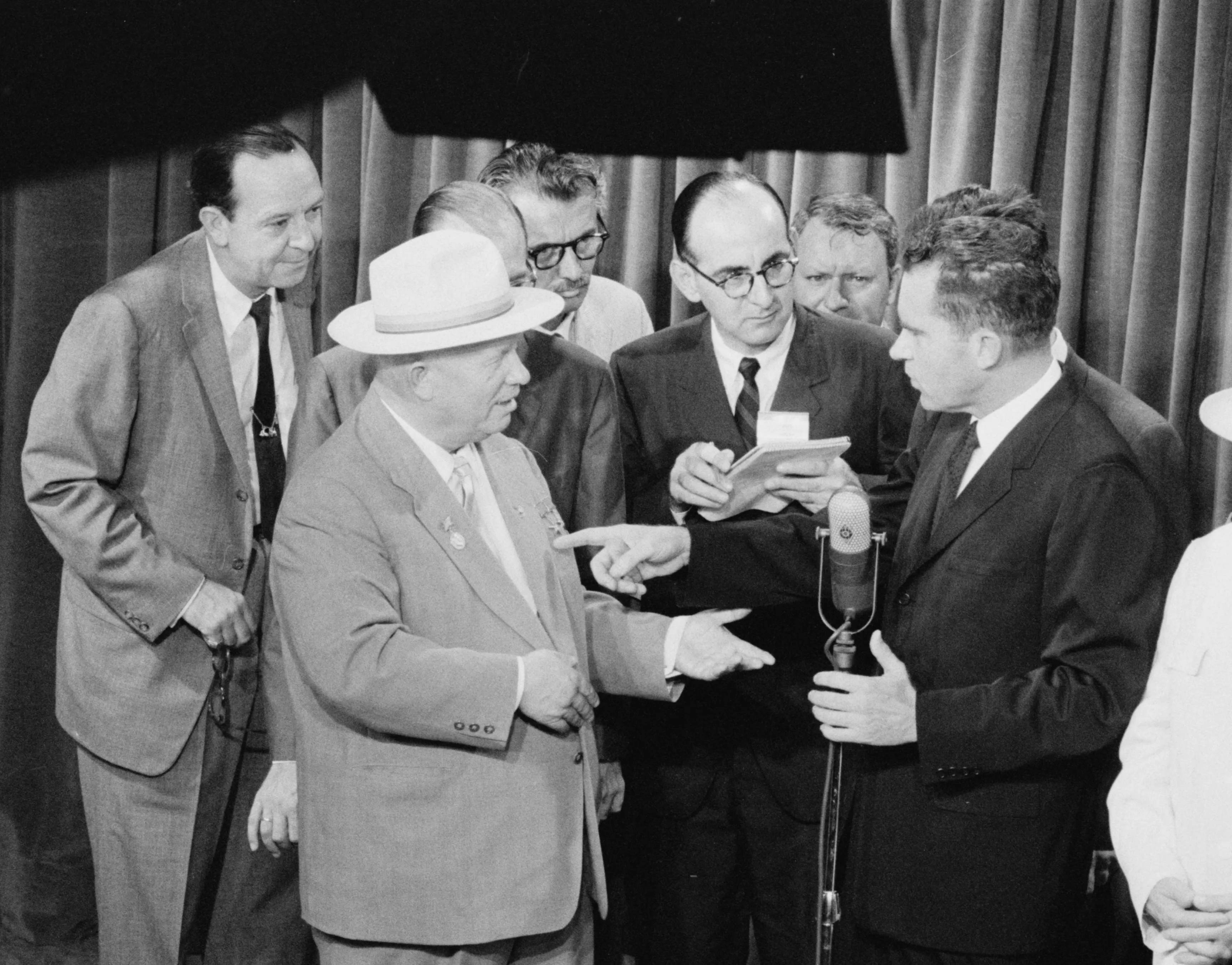
Start with 1974: the Supreme Court ruled 8-0 that Nixon had to hand over his own Oval Office tapes, and within days the "Smoking Gun" recording surfaced, Nixon's own voice ordering the CIA to choke off the FBI's investigation. Worth a longer look: 1959, when a model kitchen in Moscow turned into Nixon arguing dishwashers with Khrushchev on live tape, Cold War rivalry reduced to appliances. Apollo 11's splashdown rounds out the day, a mission that ended exactly as promised eight years earlier.
— The Patriot Compass desk
1974Featured · This day in history
Supreme Court rules 8-0: Nixon must hand over the tapes
For a year, Richard Nixon had refused to release the secret recordings from his own Oval Office, citing executive privilege and the confidentiality of presidential conversations. On July 24, 1974, the Supreme Court disagreed, unanimously, ruling in United States v. Nixon that the president had no authority to withhold the tapes from special prosecutor Leon Jaworski. Nixon complied. Within days the "Smoking Gun" tape surfaced, a June 23, 1972 recording of Nixon ordering the CIA to pressure the FBI into halting the Watergate investigation.
United States v. Nixon settled for the first time that a sitting president cannot claim absolute privilege to block a criminal subpoena. Chief Justice Burger's opinion set the precedent that presidential privilege has limits, and the ruling forced the tape's release that ended Nixon's presidency within sixteen days.
Did you know
QHow did investigators even find out the tapes existed?
Almost by accident. Alexander Butterfield, a White House aide, was being asked routine questions by Senate investigators in July 1973 about how Nixon kept track of his conversations. Butterfield answered honestly that the Oval Office had been recorded automatically since February 1971, a voice-activated system installed for Nixon's own historical record-keeping. No one had asked directly before. The admission turned a slow-moving scandal into a hunt for physical evidence, and within weeks special prosecutor Archibald Cox had subpoenaed the recordings that ended the presidency that made them.
QWhy did Nixon fire his own attorney general and deputy attorney general in one night?
Because they refused to fire someone else. On October 20, 1973, Nixon ordered Attorney General Elliot Richardson to dismiss special prosecutor Archibald Cox, who had subpoenaed the tapes. Richardson resigned rather than do it. The order then passed to Deputy Attorney General William Ruckelshaus, who also resigned. It finally fell to Solicitor General Robert Bork to carry out the firing. Three officials cycled through the decision in a single evening. The press dubbed it the Saturday Night Massacre.
QWhat exactly was on the tape that finished Nixon's presidency?
A tape recorded six days after the break-in. Recorded June 23, 1972, just six days after the DNC break-in, the tape captured Nixon instructing aide H.R. Haldeman to have the CIA tell the FBI that further investigation risked exposing the Bay of Pigs operation, a pretext to get agents to stand down. Nixon can be heard saying investigators should not be told the truth, only that it was 'a comedy of errors.' It proved the cover-up began almost immediately, not months later as Nixon had claimed.
The Daily Record · free by email
Tomorrow's edition in your inbox — one story, one quote, the flag.
1969exploration
Apollo 11 splashes down in the Pacific; Armstrong, Aldrin and Collins are home
Four days after lifting off from the lunar surface, Apollo 11's crew still had one hurdle left: re-entry through Earth's atmosphere at extremely high speed. On July 24, 1969, the Command Module Columbia, carrying Neil Armstrong, Buzz Aldrin, and Michael Collins, splashed down safely in the Pacific Ocean. The mission had fulfilled the goal President Kennedy set in 1961, landing men on the Moon and bringing them home before the decade closed. Navy divers pulled the capsule and its crew from the water. An estimated 600 million people had watched the eight-day journey unfold.
Kennedy's 1961 pledge to a joint session of Congress, made after Yuri Gagarin's orbit put the Soviets ahead in the Space Race, became a test of American industrial and scientific capacity. The splashdown closed that project eight years after Kennedy's speech. Columbia is now on display at the National Air and Space Museum.
Did you know
QWhy did Buzz Aldrin avoid mentioning communion on the Moon at the time?
Aldrin, an elder at his Presbyterian church, brought a small communion kit to the lunar surface and took the sacrament privately inside the Lunar Module before stepping outside. He chose not to describe it publicly at the time; NASA had drawn criticism after atheist activist Madalyn Murray O'Hair sued over the Apollo 8 crew's Genesis reading, and Aldrin has said he wanted to avoid stirring similar controversy. Aldrin later wrote about the moment in more detail once the legal pressure had faded. He called it a personal ritual fitting for the occasion, though it never appeared in the official transcript.
QWhat tipped Aldrin off that Eagle was about to touch the lunar surface?
Thin probes, roughly five feet long, extended down from three of Eagle's four footpads specifically to give the crew advance warning before touchdown. When one of these probes made contact with the lunar dust, it triggered a light on the instrument panel inside the cabin, telling Aldrin that contact was imminent even before he or Armstrong could feel or see it themselves. The system existed because the crew had no reliable way to judge distance on an airless surface with no familiar landmarks.
QWhat happened to the flag Armstrong and Aldrin planted on the Moon?
The American flag the two astronauts planted during their moonwalk did not survive their departure. When the ascent stage of Eagle fired its engine to lift off the lunar surface and rejoin Collins in orbit, the exhaust blast knocked the flag over, toppling it onto the ground below. It remains there today, along with the descent stage of Eagle itself, which stayed behind on the Moon while the ascent stage carried the astronauts home.
1866government
Tennessee is back in the Union; no other rebel state gets the deal
A year after Appomattox, the eleven former Confederate states remained outside Congress, their status unsettled as President Andrew Johnson and the Radical Republicans disagreed over the terms of reunion. Tennessee broke first: its legislature ratified the Fourteenth Amendment on July 18, 1866, and Congress voted the state back into the Union on July 24. Because it had ratified before readmission, Tennessee avoided the military governorship other Southern states would soon face. The other ten states would not follow Tennessee's path for several more years, with readmissions stretching from 1868 to 1871 under Congress's own terms.
Tennessee's early ratification of the Fourteenth Amendment made it the exception to Congressional Reconstruction rather than its first success. Every other former Confederate state was instead placed under military districts and forced to ratify the amendment as a condition of return, a split that hardened the Radical Republicans' resolve to legislate Reconstruction over Johnson's vetoes.
Did you know
QWhy did Tennessee avoid the military governors imposed on other Southern states?
Timing. Tennessee ratified the Fourteenth Amendment on July 18, 1866, before Congress had finalized the harsher terms it would soon impose on the rest of the former Confederacy. Because the state had already met the federal government's core condition, Congress readmitted it on July 24 without placing it under the military district system the Reconstruction Acts would soon establish elsewhere. Every other former Confederate state ratified the amendment only after federal troops and appointed governors were already running its government. Tennessee's legislature acted six days ahead of the harsher terms and avoided the occupation the rest of the South faced.
QWhat organization formed in Tennessee just months after its readmission was set in motion?
The Ku Klux Klan was founded in Pulaski, Tennessee, in December 1866, months after the state's Fourteenth Amendment ratification and congressional readmission. Tennessee, the same state moving fastest toward readmission, was also where the Klan took root. The Klan grew into the era's most visible symbol of white resistance to the constitutional changes Tennessee's own legislature had just accepted. The legislature ratified the amendment the same year the Klan was founded in Pulaski.
QHow close did Andrew Johnson come to being removed from office over his Reconstruction fights?
Johnson was impeached by the House in 1868 for violating the Tenure of Office Act, a law Radical Republicans passed specifically to box in his authority over Reconstruction appointments. The Senate acquitted him by a single vote, the narrowest possible margin for a president to keep his office. The same congressional majority that pushed through the Reconstruction Acts over his repeated vetoes came within one senator of removing him entirely. Johnson served out the balance of his term but never regained control over Reconstruction policy.