Reading 3 of 6 free1776 Club · all 6 storiesSaturday, July 25
From the desk
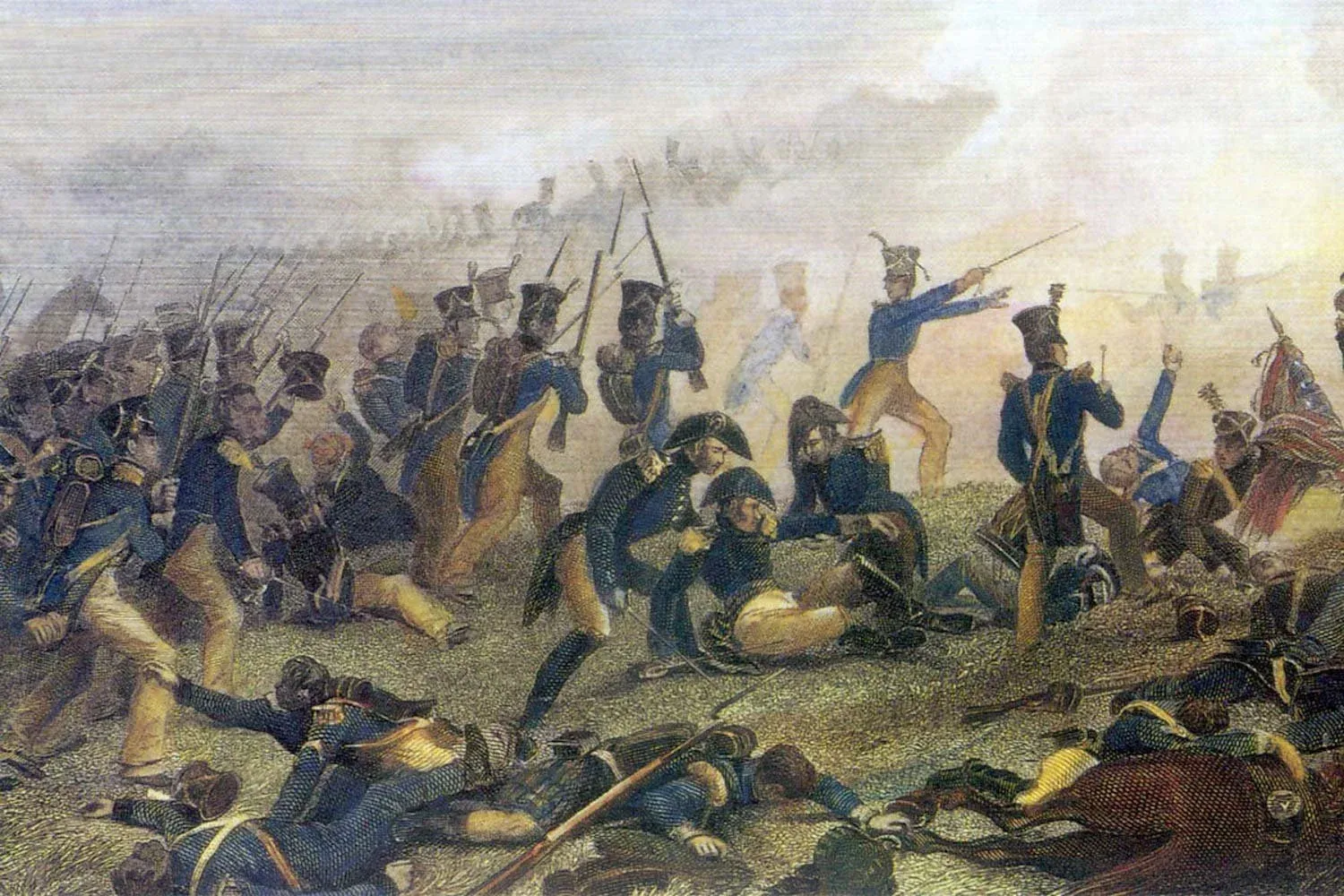
Start with 1946: the Baker test at Bikini Atoll sent a column of radioactive water into the sky, capsized the USS Arkansas, and coated the target fleet so thoroughly that decontamination crews simply gave up on it. Worth a longer look: 1814, when American and British troops fought at Lundy's Lane past midnight, close enough to bayonet each other mid-load, in the war's bloodiest battle. Also on the page, Grant became the only four-star general in the country in 1866, and Wyoming became a territory in 1868.
— The Patriot Compass desk
1946Featured · This day in history
A geyser of radioactive water rises 6,000 feet over Bikini Lagoon
Three weeks after the Able test fell short of its target, the Navy tried again, this time underwater. On July 25, 1946, the device nicknamed Helen of Bikini detonated 90 feet beneath Bikini Lagoon, punching a vertical column of water and steam into the sky above the assembled target fleet. The USS Arkansas, closest to the blast, had its hull crushed and its propellers torn away before it settled upside down in the crater. Radioactive sea spray coated every ship in range. Decontamination crews eventually gave up, and only nine of the surviving vessels were ever scrapped.
Baker forced the American military to confront a hazard its own admirals hadn't planned for: a battle-ready fleet could survive a blast and still be unusable, its decks too radioactive to work on. The Countermeasure Wash Down System the Navy later installed on ships, and the caution that shaped Cold War nuclear doctrine, both started with the failed cleanup at Bikini Lagoon.
Did you know
QWhy is a swimsuit named after a nuclear test site?
Four days after the Baker test made headlines worldwide, French designer Louis Réard unveiled a scandalously small two-piece swimsuit and named it after Bikini Atoll, hoping the design would cause the same stir as the bomb. He reportedly described his creation as being like the bomb: small and devastating. The Baker device itself carried a matching nickname, Helen of Bikini, part of a femme-fatale theme that ran through both Crossroads shots.
QWhat happened to the animals left aboard the target ships?
Roughly 200 pigs, 204 goats, 5,000 rats, 200 mice, 60 guinea pigs, and assorted insects were placed aboard target vessels to study biological effects of the blasts. Blandy told the press in September 1946 that suffering among the animals was negligible, that an animal merely languished and recovered or died a painless death. That claim was later shown to be inaccurate once fuller records of the animals' deaths emerged.
QHow did scientists actually detect the plutonium contamination that halted cleanup?
Dr. Stafford Warren, the Army colonel overseeing radiation safety, needed a way to convince Blandy that decontamination was hopeless. The breakthrough came from a self x-ray of a contaminated fish, a simple image that showed plutonium had worked its way into marine life feeding in the lagoon. Warren later credited that single image with doing the trick and pushing Blandy to halt the cleanup effort on August 10, 1946.
The Daily Record · free by email
Tomorrow's edition in your inbox — one story, one quote, the flag.
1866military
Congress creates a new rank so Grant outranks every soldier alive
A year after Appomattox, no existing rank matched what Ulysses S. Grant had become to the Union Army. On July 25, 1866, Congress passed legislation creating the rank of General of the Army and promoted Grant into it, placing him above every other officer in uniform. He had already worn the three stars of Lieutenant General, a rank last held by George Washington. Now he wore four, with the buttons on his coat arranged in three groups of four, and he was the only man in the country entitled to wear them.
Grant was elected President in 1868, and by then Congress's rank had already settled who outranked whom in the Army, a fact that mattered once he moved into civilian office during Reconstruction. The rank became a singular American honor, held by only three men before disappearing until revived for Eisenhower and Marshall's generation in World War II.
Did you know
QHow many men ever held the original four-star General of the Army rank?
Only three: Grant first in 1866, then William Tecumseh Sherman when Grant became President in 1869, then Philip Sheridan after Sherman. Each held it alone, one at a time, unlike the later five-star version created for World War II, which could be held by multiple officers at once and was eventually held by five men: Marshall, MacArthur, Eisenhower, Arnold, and later Omar Bradley. When Sheridan died in 1888, the rank simply ceased to exist. Nobody replaced him. The rank stayed empty until 1944, when Congress created the five-star version.
QWhat happened to Grant's rank in the final weeks of his life?
In 1885, as Grant lay dying of throat cancer and racing to finish his memoirs to provide for his family, Congress passed legislation restoring his rank of General of the Army, which he had given up in 1869 upon becoming President. Grant died shortly afterward, holding the rank Congress had restored to him.
QWhat did Grant think of Custer, another famous Army officer of his era?
Grant had no patience for Custer's judgment. After the Battle of the Little Bighorn, Grant said he regarded "Custer's massacre as a sacrifice of troops, brought on by Custer himself, that was wholly unnecessary." It's a blunt line from a man who by then held the Army's highest possible rank and had little tolerance for recklessness that cost soldiers their lives.
1868government
Congress Carves Wyoming Territory Out of Three Older Territories
By 1868, the Union Pacific Railroad was pushing west across a patchwork of jurisdictions that had already changed hands half a dozen times since the Louisiana Purchase. On July 25, President Andrew Johnson signed the Wyoming Organic Act, carving a new territory from pieces of Dakota, Idaho, and Utah territory. Cheyenne became the territorial capital. Wyoming entered the Union in 1890, twenty-two years later, with almost the same borders.
Wyoming Territory's 1869 grant of women's suffrage, adopted partly to draw settlers, was one of the earliest in the United States to grant women full voting rights. A repeal attempt later died by a single vote in the legislature after the governor's veto. That 1869 law remains a foundational part of Wyoming's identity and is frequently cited in discussions of the history of women's suffrage in the United States.
Did you know
QHow many different territories claimed pieces of Wyoming before 1868?
At least six. The land moved through Nebraska Territory, Dakota Territory (twice, in 1861 and again in 1864), Idaho Territory, and Utah Territory before Congress finally drew Wyoming's own boundary in 1868. The southwest corner alone passed through Utah and Nebraska Territory before landing in Idaho Territory by 1863. Few American territories were reassembled from so many prior jurisdictions in so short a span.
QHow close did Wyoming's women's suffrage law come to being repealed?
One vote. After the territorial governor vetoed a legislative attempt to repeal the 1869 suffrage law, opponents tried to override his veto and fell exactly one vote short. Had that single vote gone the other way, Wyoming would have lost its claim as the first U.S. jurisdiction to grant women the right to vote.
QWhy did Wyoming's 1872 counties look like tall, narrow rectangles?
The territory's five original counties, Albany, Carbon, Laramie, Sweetwater, and Uinta, were each carved to span roughly one-fifth of Wyoming's width, running north to south in long strips rather than compact blocks. The narrow, elongated shape of each county reflected the territory's overall land division into five roughly equal north-south strips.