Reading 3 of 7 free1776 Club · all 7 storiesWednesday, August 5
From the desk
Start with 1864: Farragut pushing eighteen ships past three forts and sixty-seven mines at Mobile Bay, watching the Tecumseh go down in minutes, and ordering the fleet forward anyway. The Tennessee fought alone until her rudder chains parted. Worth a longer look: the 1963 test ban treaty signed in Moscow, born from strontium-90 turning up in children's teeth, which banned atmospheric and underwater blasts but left underground testing untouched. Spare a glance for 1620, when the Mayflower's companion ship sprang a leak before either vessel cleared the English coast.
— The Patriot Compass desk
1864Featured · This day in history
"Damn the torpedoes": Farragut runs the Mobile Bay minefield
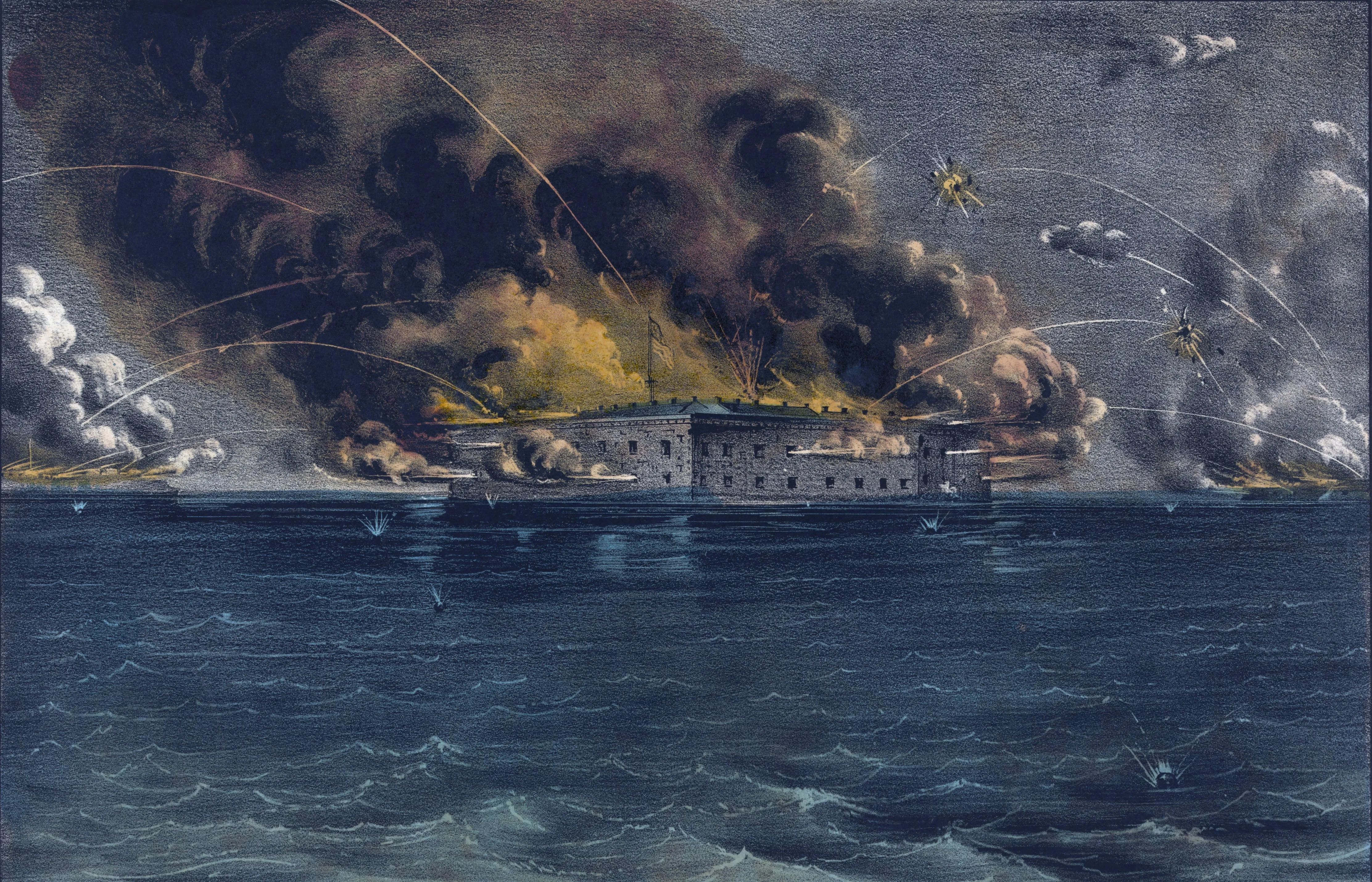
By August 1864, Mobile was the last major Confederate port left open on the Gulf east of the Mississippi, its harbor guarded by three forts, sixty-seven planted mines, and the ironclad ram CSS Tennessee. Rear Admiral David Farragut pushed eighteen Union vessels into the channel on August 5. When the monitor USS Tecumseh struck a mine and sank in minutes, Farragut ordered the fleet forward regardless. The Tennessee fought alone until her rudder chains parted and her smokestack was shot away; she surrendered. The forts followed within days.
Closing Mobile Bay ended Gulf blockade-running east of the Mississippi and handed Lincoln a battlefield win three months before the November election, just as his re-election looked shaky. Farragut's order, paraphrased ever since as "damn the torpedoes, full speed ahead," became a fixture of American vocabulary for reckless resolve, quoted in boardrooms and political speeches for a century and a half afterward.
Did you know
QWho took over Fort Gaines and Fort Powell when their main commander was away?
Confederate defenses at Mobile Bay had a chain of command below Brigadier General Richard L. Page, who oversaw all three forts. When Page was absent, Colonel Charles D. Anderson commanded Fort Gaines and Lieutenant Colonel James M. Williams commanded Fort Powell. Fort Morgan carried the heaviest armament of the three at 46 guns, compared to Fort Gaines' 26 and Fort Powell's 18. Despite this layered command structure and combined ninety guns across the three forts, all three surrendered within days of the naval battle, following the disabling of the Tennessee rather than falling from prolonged siege. The forts' fall completed Union control of the bay's entrance faster than their gun counts might suggest.
QHow did the Union fleet's ships differ beyond the four ironclad monitors?
Farragut's eighteen-vessel fleet was not simply wooden ships and monitors. It included eight conventional wooden-hulled warships and four monitors, but also three unusual double-enders, gunboats designed with rudders and helm stations at both bow and stern so they could reverse direction in a narrow channel without turning around. That design mattered in a bay laced with mines and forts on both sides, where a ship pinned in a tight channel needed to retreat instantly. The double-enders gave Farragut tactical flexibility his heavier monitors lacked. Facing them, the Confederate Navy could field only three small sidewheel gunboats, the Selma, Morgan, and Gaines, alongside the ironclad Tennessee.
QWhat role did Captain Percival Drayton play beyond commanding Farragut's flagship?
Percival Drayton commanded the USS Hartford, the ship to which Farragut had himself lashed in the rigging during the battle. When Farragut gave his famous order, he addressed Drayton directly by name, telling him to go ahead at four bells before calling for full speed to Jouett. Because the order was addressed to Drayton specifically, the Hartford's move past the stalled Brooklyn depended on his immediate compliance. The rest of the fleet followed the Hartford past the minefield and into the bay.
The Daily Record · free by email
Tomorrow's edition in your inbox — one story, one quote, the flag.
1620exploration
Mayflower sails for America; her companion ship is already taking on water
A congregation of English separatists, exiled in Holland for over a decade and squeezed by a new Anglo-Dutch alliance that banned their independent worship, had staked everything on a crossing to North America. On August 5, 1620, the Mayflower left Southampton in company with the smaller Speedwell, carrying settlers toward a colony that did not yet exist. The Speedwell sprang a leak almost immediately, and both ships put in at Dartmouth for repairs. It was not her last leak, or her last delay.
This false start, and the abandonment of the Speedwell off the English coast beyond Land's End that followed, is why the Mayflower alone carried 102 passengers into Cape Cod that November and why they wrote the Mayflower Compact before ever setting foot on land. That improvised charter became the founding document Americans point to when they trace self-government back before the Constitution and before the Revolution, to a ship's cabin off Cape Cod.
Did you know
QHow cramped were the quarters below deck on the Mayflower during the crossing?
The passenger space measured roughly 20 by 80 feet, with a ceiling only five feet high, forcing most adults to stoop or crouch for the entire ten-week voyage. That single deck held all 102 passengers, their belongings, and whatever provisions they could not stow elsewhere. During storms, seawater washed through the semi-darkness as people huddled below, soaked and unable to stand upright. There was no privacy and little room to move. The ship itself was 110 feet long and 25 feet in beam, so the human cargo occupied only a fraction of a working merchant vessel never designed to carry passengers at all, let alone through a North Atlantic autumn.
QWhat tool saved the Mayflower when a main beam cracked mid-ocean?
A colonist's metal jackscrew, a device meant for jacking up house timbers on land, was pressed into service to force the ship's cracked main beam back into place during a violent Atlantic storm. Without it, the cracked beam threatened to leave the ship disabled far from any coast. The improvisation held long enough for the Mayflower to continue on to Cape Cod. The ship also carried live cargo below deck alongside the passengers, including dogs, sheep, goats, pigs, and poultry meant to stock the colony once it existed, all riding out the same storm in the same cramped hold.
QWhat happened to the Mayflower after it delivered the Pilgrims to Plymouth?
No record of the ship survives past 1624. Captain Christopher Jones sailed her back to England after the colonists disembarked, but within a few years she vanishes from the historical record entirely. Historians believe she was eventually broken up for scrap, her timbers repurposed into ordinary building construction somewhere in England, an unremarkable end for a vessel that had spent over a decade as a working merchant ship before 1620. There is no preserved wreck, no surviving hull, no relic beyond the name itself, which outlived the physical ship by centuries to become one of the most recognized in American memory.
1963government
Three powers agree: no more bombs in the sky, underwater, or in space
By 1963, strontium-90 was showing up in children's teeth and mothers' milk, and scientists like Linus Pauling had gathered more than 9,000 signatures warning of fallout from atmospheric testing. In Moscow on August 5, negotiators for the United States, the United Kingdom, and the Soviet Union signed the Partial Nuclear Test Ban Treaty, banning nuclear explosions above ground, underwater, and in outer space. Underground testing stayed legal. The treaty, the first major arms-control deal of the Cold War, took effect that October.
Kennedy signed the treaty about eight weeks after his American University speech calling for a thaw with Moscow, and about six weeks after installing the Washington-Moscow hotline. It marked the first time American nuclear policy bent toward negotiated limits rather than unrestrained buildup.
Did you know
QHow many countries eventually joined a treaty signed by just three nations?
The Partial Test Ban Treaty started as a three-way deal between Washington, London, and Moscow, but it grew into one of the most joined agreements of the era, with 123 other states eventually signing on. Eventually 123 other states signed on as parties, while ten more signed but never ratified it. France and China refused entirely, and kept testing in the open air for years, France until 1974 and China until 1980.
QWhat tipped off scientists that fallout was reaching American children?
Researchers ran what became known as the Baby Tooth Survey, collecting baby teeth from thousands of American children and testing them for strontium-90, a radioactive isotope that behaves like calcium in the body and lodges in bone and teeth. The survey confirmed that fallout from atmospheric testing was showing up inside American kids, not just drifting harmlessly over test sites in Nevada and the Pacific. That data became a central piece of evidence in the public campaign against atmospheric testing.
QDid a mysterious 1979 flash of light ever get pinned on anyone?
In September 1979, a US satellite detected a double flash over the South Atlantic consistent with a nuclear detonation, an event now called the Vela incident. Suspicion fell on Israel and South Africa, both signatories to the test ban treaty, but neither country has ever confirmed responsibility and no formal accusation was ever proven. No one has ever been formally blamed for it.