Reading 3 of 5 free1776 Club · all 5 storiesThursday, August 6
From the desk
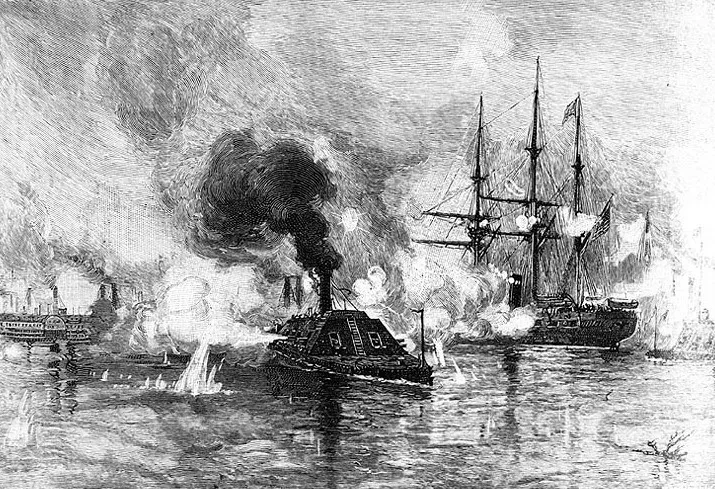
Start with 1945. Paul Tibbets lifted the Enola Gay off Tinian before dawn with a single bomb called Little Boy, and by morning three-quarters of Hiroshima was gone, some 70,000 to 80,000 dead in an instant that changed what war meant. Worth a longer look: 1965, when Johnson signed the Voting Rights Act after Selma's beatings on the Pettus Bridge forced Congress's hand, and registration rolls surged within months. The CSS Arkansas, scuttled near Baton Rouge rather than surrendered, is a smaller story but a hard one to look away from.
— The Patriot Compass desk
1945Featured · This day in history
The Enola Gay drops the first atomic bomb used in war on Hiroshima
By August 1945, the United States had spent years developing a weapon no one had ever used in war. Before dawn on August 6, the B-29 Enola Gay, piloted by Paul W. Tibbets Jr., lifted off from Tinian carrying a single bomb called Little Boy. Over Hiroshima that morning, the bomb detonated, destroying about three-quarters of the city and killing an estimated 70,000 to 80,000 people from the blast and resultant firestorm. Japan did not surrender immediately, and a second bomb fell on Nagasaki three days later.
Truman's decision to use the bomb ended the war without a mainland invasion, but it opened a debate over the bombing's morality that has never been resolved. The Enola Gay itself became the center of controversy decades later, when the Smithsonian's plans to display it alongside the human cost of the bombing set off a fight over how the nation should remember its own weapon.
Did you know
QWhat chain of events actually led the United States into World War II years after fighting began in Europe?
The United States stayed out of the war for more than two years after Germany invaded Poland on September 1, 1939, which triggered declarations of war from the United Kingdom and France. That changed on December 7, 1941, when Japan attacked Pearl Harbor. The strike drew the US directly into a conflict that had already engulfed Europe, North Africa, and Asia. Roosevelt was president throughout this stretch, guiding the country from neutrality into full mobilization. By the time Hiroshima was bombed nearly four years later, the war had already claimed tens of millions of lives in Europe, North Africa, and Asia.
QHow much deadlier was World War II than any conflict before it?
Estimates put the death toll between 60 and 75 million people, the vast majority of them civilians rather than soldiers. That range makes it the deadliest conflict in recorded history, a scale driven by industrialized warfare, bombing campaigns, and mass starvation across occupied territories. The war's roots stretched back well before 1939, through Japan's 1931 invasion of Manchuria, the Spanish Civil War, and the 1937 outbreak of the Second Sino-Japanese War. Germany's annexations of Austria and the Sudetenland added further tinder. Hiroshima and Nagasaki were single events within a war whose overall human cost dwarfed nearly every other conflict combined.
QWhat formal steps closed out the war after Japan's surrender announcement on August 15, 1945?
Hirohito's radio broadcast on August 15 announced Japan's intent to surrender, but the war did not legally end until a formal surrender document was signed on September 2, 1945, aboard the USS Missouri. General Douglas MacArthur presided over that ceremony, marking the war's official close almost exactly six years after Germany's invasion of Poland began it. The gap between announcement and signature gave Allied and Japanese officials time to arrange the logistics of surrender. That September 2 signing officially ended the war in Asia, though many at the time treated the August 15 announcement as the war's practical end, bracketing a conflict that had started with Poland and ended in Tokyo Bay.
The Daily Record · free by email
Tomorrow's edition in your inbox — one story, one quote, the flag.
1965civil-rights
Johnson signs the Voting Rights Act; literacy tests are now outlawed nationwide
In early 1965, Southern registrars still used literacy tests and poll taxes to keep Black citizens off the voter rolls, though the Fifteenth Amendment had guaranteed Black men the vote since 1870. That March, state troopers beat marchers crossing the Edmund Pettus Bridge in Selma, and the images pushed Congress to act. On August 6, 1965, President Lyndon B. Johnson signed the Voting Rights Act, banning literacy tests and putting federal officials in charge of registration in areas with histories of discrimination. Black voter registration surged in the months that followed.
The Act put federal enforcement behind the Fifteenth Amendment for the first time since Reconstruction. It reshaped Black voter registration across the South, and later Supreme Court rulings have since narrowed some of its enforcement provisions.
Did you know
QWho was Jim Clark, and why did his name end up tied to the law?
Jim Clark was the sheriff of Dallas County, Alabama, where Selma sits, and his aggressive, often violent resistance to Black voter registration drives made him a fixture of national news coverage in early 1965. His deputies' rough handling of registration lines and protests gave television audiences outside the South a direct look at the mechanics of disenfranchisement. Clark's visibility on national television did more than any speech to show viewers what local resistance to Black registration looked like.
QWhat slogan did SNCC organizers use during the Selma voting drive?
James Forman of the Student Nonviolent Coordinating Committee described the group's approach as designed to force federal intervention or expose its absence, and the campaign's rallying phrase was "One Man, One Vote." Forman later wrote that the strategy counted on either drawing the government in or proving, through its inaction, that Washington was not on the side of Black voters. Forman said either outcome would put the government's position on the record for Black voters watching Selma.
QDid the Civil Rights Act of 1964 already cover voting discrimination?
Only partly. The 1964 law included some voting rights language, but it did not prohibit most of the actual devices, literacy tests, discriminatory registration procedures, and similar barriers, that Southern registrars used to keep Black citizens off the rolls. That gap is why organizers kept pushing after 1964 and why the Selma campaign focused on registration practices specifically.
1960government
Havana seizes American holdings; Washington cancels the sugar quota within a day
For decades, American money had run Cuba's sugar mills, utilities, and Havana's casino floors, even as nearly a third of the island's workforce lacked full-time employment. On July 5, 1960, Fidel Castro's government nationalized U.S. companies and property outright, with full seizure of American holdings completed by year's end. Washington answered fast: the sugar quota was canceled the very next day, and a broad trade embargo followed on October 19, sparing only food and medicine. Cuba had already turned toward Moscow that spring.
American companies had owned Cuba's sugar mills, phone lines, and power plants for half a century; losing them in a single year forced Washington to build its first Cold War trade embargo, a policy that remains in place today. The cancellation of Cuba's sugar quota on July 6, 1960, came one day after the seizures, one of the fastest economic retaliations in American diplomatic history.
Did you know
QWhy was Havana once called the Cadillac capital of the world?
By 1954, Havana had more Cadillacs per capita than any city on earth, a rolling display of wealth that sat alongside an economy where nearly a third of the labor force went underemployed. The contrast was stark: luxury automobiles cruised streets minutes from neighborhoods with no running water. That gap between visible consumption in the capital and deprivation elsewhere became part of the resentment Castro's movement drew on. The Cadillacs weren't a footnote to Cuba's crisis. They were a symbol of it, proof that American-linked prosperity had pooled in Havana while the rest of the island went without.
QHow much worse was healthcare access in rural Cuba compared to Havana?
In Oriente province, one doctor served every 2,423 people. In Havana, the ratio was one doctor for every 227. That is roughly a tenfold gap in medical access between the capital and the countryside, and only 15 percent of the rural population had running water at all. These disparities predated Castro's rise to power. The numbers explain why nationalization, when it came in 1960, was framed in Cuba not only as an economic maneuver against American firms but as a correction of decades of uneven investment between Havana and the rest of the island.
QWhat made Fidel Castro nationally famous before he ever led a revolution?
A courtroom speech. After the failed Moncada Barracks attack on July 26, 1953, Castro stood trial and delivered a two-hour address laying out his grievances against Batista's dictatorship. The speech won him national recognition years before he set foot back in Cuba as a guerrilla leader. It also gave the eventual movement its name: the 26th of July Movement, marking the date of the attack that had landed him in prison. Castro used his own trial as a stage, turning a legal defeat into the founding myth of the organization that would carry him to power in 1959.