Reading 3 of 6 free1776 Club · all 6 storiesSunday, August 9
From the desk
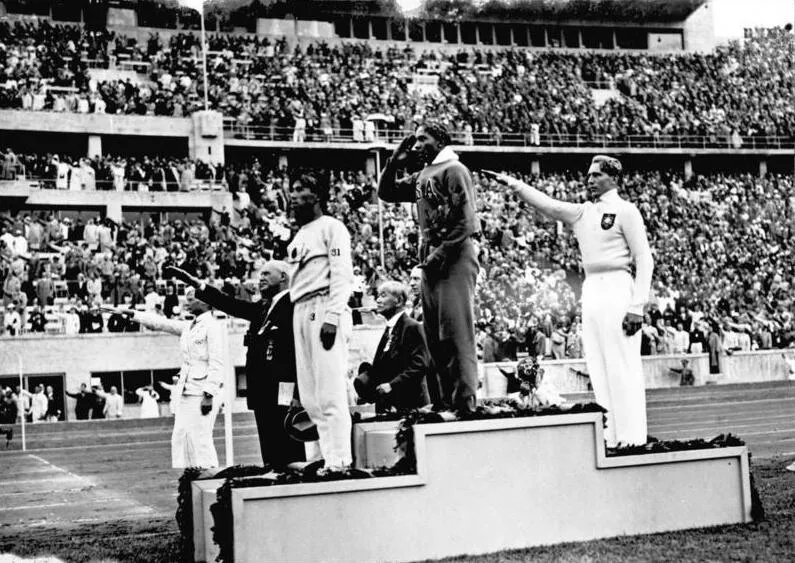
Start with 1945. Bockscar took off with a second bomb ready and a backup target chosen, and only reached Nagasaki because clouds covered the first one. Fat Man killed an estimated 35,000 people in an instant, and the plane itself nearly didn't make it back, landing on Okinawa with less than five minutes of fuel left. Worth a longer look: Jesse Owens taking his fourth gold in Berlin in 1936, in a stadium built to prove the opposite point. Savo Island rounds out the day, a night battle the Allies lost badly and almost nobody remembers.
— The Patriot Compass desk
1945Featured · This day in history
Bockscar drops a second atomic bomb, on Nagasaki
Three days after Hiroshima, American planners had a second atomic bomb ready and a second target chosen. On the morning of August 9, 1945, the B-29 Bockscar, piloted by Charles W. Sweeney, took off from Tinian carrying the Fat Man bomb, an implosion-type weapon built by the Manhattan Project. Clouds over the primary target forced a diversion to Nagasaki, where the bomb detonated at 1,650 feet, destroying 44 percent of the city and killing an estimated 35,000 people. Bockscar, low on fuel from a failed transfer pump, landed on Okinawa with less than five minutes to spare.
Nagasaki was the last atomic bomb the United States has used in war, and the decision to drop it, made under weather delays and a failing fuel pump rather than a clean plan, has shaped six decades of American argument over Truman's choice and the ethics of the bomb. Bockscar itself now sits in Dayton, Ohio, a permanent, physical prompt for that unresolved national debate.
Did you know
QWhy did Bockscar's tail number change from 7 to 77 just before the mission?
Bockscar originally carried the Victor number 7, but on August 1, 1945, ground crews repainted it as 77. The switch wasn't cosmetic. An actual aircraft from the 444th Bombardment Group already used a number close enough to cause confusion in flight logs and radio traffic, and commanders wanted no chance of mixing up a routine bomber with the plane assigned to carry an atomic weapon. The renumbering happened just over a week before the mission, during the same stretch when Bockscar was running practice drops. The renumbering was a paperwork fix meant to keep Bockscar from being confused with another B-29 on any manifest.
QWhat did Bockscar practice in the week before dropping Fat Man?
Bockscar flew three test-drop rehearsals with inert Pumpkin bombs in the eight days before the mission, letting the crew practice the exact release profile they would need for the live weapon.
QWhy did the crew give up on Okinawa's control tower before landing?
Bockscar circled Yontan Airfield for 20 minutes trying to reach the control tower by radio, got no response, and finally decided its own radio was broken rather than that no one was answering.
The Daily Record · free by email
Tomorrow's edition in your inbox — one story, one quote, the flag.
1944culture
Bambi's loan runs out; the Forest Service names a bear of its own
By the summer of 1944, America's national forests were short on the men who normally fought fires. Most experienced firefighters were overseas, and Japan had already tried to turn the woods into a weapon: shelling an oil field near Los Padres National Forest in 1942 and, later in the war, launching some 9,000 incendiary balloons into the jet stream toward the Pacific coast (with an estimated 11% reaching the U.S. between November 1944 and April 1945). Disney had loaned the government Bambi for a year of fire-prevention posters, but the deal was expiring. On August 9, 1944, the U.S. Forest Service authorized a bear of its own: Smokey.
Smokey Bear became the longest-running public service campaign in U.S. history, and the government moved fast to protect it. Congress passed the Smokey Bear Act in 1952, putting the character's name and image under the Secretary of Agriculture's control, an unusual step that treated a cartoon bear as a piece of federal property worth defending in law.
Did you know
QWhat did Smokey Bear actually eat at the National Zoo?
Smokey's official diet was bluefish and trout, standard fare for a captive black bear, but he developed a personal fondness for peanut butter sandwiches on the side. Zookeepers reportedly indulged the habit for 26 years, the length of time he lived at the National Zoo in Washington, D.C. A bear famous for warning children about careless campfires spent his actual days eating a lunch-counter staple rather than anything foraged from a forest. The detail never made it onto a poster, but it made the federal mascot feel like a real animal with real habits, not just a drawing in a campaign hat.
QWhy is Smokey's name spelled differently from the word 'smoky'?
The extra 'e' in Smokey Bear was deliberate from the start, a spelling choice made to separate the character's name from the plain adjective describing smoke-filled air. It was an intentional branding decision baked in from 1944 onward. The spelling stayed the same across posters, comic strips, radio spots, and merchandise for decades. A single letter kept a cartoon bear's name legally and visually distinct from an ordinary English word, a small piece of trademark discipline built into a friendly forest-safety mascot.
QWhere did a giant mechanical Smokey Bear turn up?
The Ohio State Fairgrounds, in 1959, where fairgoers could stand next to a 14-foot-tall animatronic version of the bear. He also crossed into rock and roll a few years later: the Beach Boys name-checked his slogan in their 1964 song "Drive-In," needling a couple caught not watching the movie by quoting his own line about preventing forest fires back at them.
1942military
In the dark off Guadalcanal, Mikawa's cruisers sink four Allied warships in under an hour
Two nights after Marines waded ashore on Guadalcanal, the Allied warships guarding their transports were running on half crews and short sleep. Just after 1 a.m. on August 9, 1942, Vice Admiral Gunichi Mikawa's column of seven cruisers and a destroyer slipped past a gap in the Allied patrol lines and opened fire in the strait north of Savo Island. Within an hour they sank HMAS Canberra and the American cruisers Vincennes, Astoria, and Quincy, suffering almost no damage themselves. Mikawa then withdrew north without touching the invasion transports still anchored offshore.
This was, in Naval History and Heritage Command's own reckoning, one of the costliest single defeats in U.S. naval history. Yet Mikawa's decision to withdraw rather than destroy the transports let American forces hold Henderson Field, the airstrip that anchored six more months of grinding campaign on Guadalcanal.
Did you know
QWhy did Chicago's captain barely use his ship's radar during the battle?
Captain Howard Bode of the cruiser USS Chicago switched his radar on only intermittently that night, worried that its transmissions might reveal his ship's position to any nearby Japanese vessels. It was a reasonable-sounding precaution in August 1942, when radar was still new enough that commanders weren't sure whether it gave away more than it revealed. The tradeoff proved costly: intermittent radar meant intermittent warning, and Chicago was among the ships caught flat-footed when Mikawa's column appeared out of the dark.
QWhat did Japanese floatplanes do to Canberra and Chicago right before the shooting started?
Japanese scout planes dropped flares directly over Canberra and Chicago, lighting up the Allied ships just before Mikawa's cruisers opened fire. The illumination stripped away any advantage of darkness the Allied vessels might have had and gave Japanese gunners a clean silhouette to aim at from the surrounding blackness. Crews already worn down from days on half-crew rest cycles had no warning beyond the sudden glare overhead. The first Allied sailors to die that night never saw the ships that killed them.
QDid any Allied crew actually see Mikawa's ships coming and just not report it?
Japanese floatplanes flew ahead of Mikawa's force dropping flares to illuminate the Allied anchorage, and multiple Allied ships heard the aircraft and saw the flares that night. None of the ships that observed them treated the sightings as an actionable warning, and no alert went out up the chain of command. A widely repeated postwar claim held that an Australian reconnaissance crew spotted the Japanese force hours earlier and delayed reporting it to have tea before landing, a story later shown to be false.