Reading 3 of 6 free1776 Club · all 6 storiesSunday, August 16
From the desk
Start with 1780: before dawn outside Camden, Cornwallis's 2,239 regulars met Gates's larger but green army, and within an hour the militia had broken, Tarleton's cavalry had shattered the Continental rear, and the Americans had lost over 2,000 men and every gun they carried. It's the clearest lesson in the day's edition on what untested troops cost. Worth a longer look: 1927, when eight planes left Oakland chasing a Honolulu prize and only two landed. The Dole Race's other four simply vanished or turned back, which tells you more about that era's flying than any triumph would.
— The Patriot Compass desk
1780Featured · This day in history
Militia flee in the dark; Cornwallis shatters Gates's army near Camden
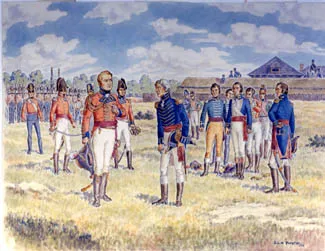
Before dawn on August 16, 1780, two armies stumbled into each other on a sandy road four miles north of Camden, South Carolina. Lord Cornwallis's 2,239 British regulars faced Horatio Gates's larger but green force of 3,052, two-thirds of them untested militia. When Cornwallis's line advanced firing and shouting, the Virginia militia broke first, then the North Carolinians. Banastre Tarleton's cavalry crashed into the exposed Continental rear. Within an hour the American army had lost over 2,000 men and its entire artillery. Gates never commanded in the South again.
Camden cost Gates his command and his reputation and forced Congress to hand the southern war to Nathanael Greene, whose patient strategy of retreat and attrition would undo Cornwallis at Yorktown. The rout also hardened the American reliance on partisan leaders like Sumter and Marion, who kept resistance alive in South Carolina while the Continental Army rebuilt.
Did you know
QHow many men did Gates lose compared to Cornwallis at Camden?
Gates's army suffered more than 2,000 casualties out of roughly 3,052 men, while Cornwallis lost only 69 killed, 245 wounded, and 11 missing from a force of 2,239. Of the identified American dead, 162 were Continental regulars, 63 were North Carolina militiamen, 12 were South Carolina militiamen, and just 3 were Virginia militiamen, a low count consistent with reports that the Virginia line ran before the shooting truly started. The Americans also lost all eight of their field cannon and more than 200 wagons.
QWhat happened to the 200-plus wagons the Americans lost at Camden?
Gates's army did not just lose men and cannon, it lost its entire supply train: upwards of 200 wagons along with the greatest part of the army's baggage fell into British hands or were abandoned along the retreat route. Combined with eight captured field pieces, the loss stripped the southern Continental Army of the equipment it would have needed to campaign again immediately. Rebuilding artillery and wagon trains took months, forcing Nathanael Greene, once he took command, to fight a campaign of maneuver and retreat partly because he lacked the heavy logistics to do otherwise. The lost wagons help explain why Greene's early campaign relied on maneuver rather than heavy logistics.
QWhat happened to Captain Richard Dorsey after the battle?
Captain Richard Dorsey, an American officer, was wounded in the fighting and captured by the British before the day was out, one of many Continentals swept up in the collapse of the Maryland and Delaware lines. His capture came amid the same general collapse that swept up hundreds of other Continentals that afternoon. Dorsey's fate was shared by hundreds of Continental regulars taken prisoner that single afternoon.
The Daily Record · free by email
Tomorrow's edition in your inbox — one story, one quote, the flag.
1927tragedy
Eight planes race for Honolulu; the fog barely lifts in time
A crowd of up to 100,000 packed Oakland Municipal Airport on August 16, 1927, to watch eight planes chase pineapple magnate James Dole's $25,000 prize for the first nonstop flight to Honolulu. Fog had only lifted at 10:40 that morning. Oklahoma took off first just after noon, followed within thirty-six minutes by El Encanto, Pabco Flyer, Golden Eagle, Miss Doran, Aloha, Woolaroc, and Dallas Spirit. Two crashed roughly a mile or less from the start, two more (Oklahoma and Dallas Spirit) turned back with mechanical trouble, and only Woolaroc and Aloha reached Hawaii.
Inspired directly by Lindbergh's Atlantic crossing three months earlier, the Dole race tested whether American aviators beyond Lindbergh could master transoceanic distance. The losses hardened public and federal resolve toward stricter licensing and navigation standards, a regulatory push born from a private pineapple executive's cash prize rather than government initiative.
Did you know
QWhat did Mildred Doran's crew throw overboard before the race even started?
Somewhere over Long Beach, the crew of Miss Doran tossed their tool kit out of the cockpit. Mildred Doran, the young Michigan schoolteacher riding along as passenger, explained afterward that the tools were "in the way and cluttering things up." Miss Doran later disappeared over the Pacific without a trace, and no wreckage was ever recovered.
QHow much of his own prize money did Aloha's winning pilot give his navigator?
Martin Jensen brought Aloha into Honolulu for second place and a share of Dole's prize purse, worth $10,000. He handed his navigator, Paul Schluter, just $25 of it. Schluter had spent 28 hours and 16 minutes in the air plotting a course across open ocean with dead reckoning, since flying so low made it impossible to sight the stars for celestial navigation, landing with the plane running on fumes.
QWhy did officials delay the race from its original date of August 12?
Dole's derby was originally scheduled for August 12, but mechanical failures, botched qualification tests, and bad weather forced a postponement. Nine of the contestants met on the night of August 11 and agreed to try again five days later. That delay didn't fix the underlying problems: three planes had already crashed in the days leading up to the race, killing three people, before a single competitor cleared Oakland's runway on August 16.
1916government
In Washington, the U.S. and Britain sign a treaty to save the birds crossing their shared border
By 1916, market hunters had pushed once-abundant birds like the passenger pigeon toward extinction, and songbirds, waterfowl, and insect-eating species that crossed the Canada-U.S. border had no federal protection on either side. On August 16, 1916, the United States and Great Britain, acting for Canada, signed the Convention for the Protection of Migratory Birds in Washington, D.C. The treaty declared shared authority over birds that ignored the boundary, leading to hunting-season limits and species protections in both countries. American law would not catch up for two more years, after Congress acted and the Supreme Court ruled.
The treaty gave Woodrow Wilson's administration a legal tool whose influence outlasted the birds it protected: when Missouri sued to block the resulting federal hunting rules as an overreach into state authority, the Supreme Court's 1920 ruling in Missouri v. Holland held that a ratified treaty could expand federal power beyond what Congress alone could claim. Courts still cite it in disputes that have nothing to do with birds.
Did you know
QWhat does Canada's 1994 update to its bird protection law actually do that the original did not?
Canada's Migratory Birds Convention Act started in 1917 but received a major overhaul in June 1994, adding stronger regulatory teeth around permits. Under the updated law, anyone wanting to hunt, traffic, or commercially deal in migratory birds, their eggs, or their nests must first obtain a permit, closing gaps that had existed in the original framework. The act also formalized the creation of Federal Migratory Bird Sanctuaries, giving Canada a designated network of protected land tied directly to the statute rather than relying on ad hoc provincial arrangements. Nearly eight decades passed between the original law and this rewrite, showing how long it took Canada to translate the 1916 treaty's broad language into enforceable domestic permitting rules.
QWhy did the treaty text specifically call out insect-eating birds alongside food species?
The treaty's opening language justified protection on two separate economic grounds: birds valued as food, and birds valued for destroying insects harmful to forests, forage plants, and agricultural crops. That second category mattered because it extended legal protection to songbirds and insectivorous species that no market hunter targeted for meat but that farmers and foresters depended on to control pests naturally. That framing, useful or harmless, let the agreement reach far beyond game birds into ordinary backyard and woodland species. Bundling pest control value with food value inside one legal definition let the agreement reach far beyond game birds into ordinary backyard and woodland species.