Reading 3 of 7 free1776 Club · all 7 storiesMonday, August 24
From the desk
Start with 1814. British troops marched into an undefended Washington and sat down to eat the dinner laid out for Madison's guests before torching the Capitol and White House. A storm doused the fires; the British left within 26 hours. Worth a longer look: 1944, when Leclerc's vanguard, La Nueve, broke from the Allied plan and reached Paris's Hôtel de Ville under fire, and Parisians answered by singing in the streets. NATO's founding in 1949 rounds out a day that ran from a capital in flames to one set free.
— The Patriot Compass desk
1814Featured · This day in history
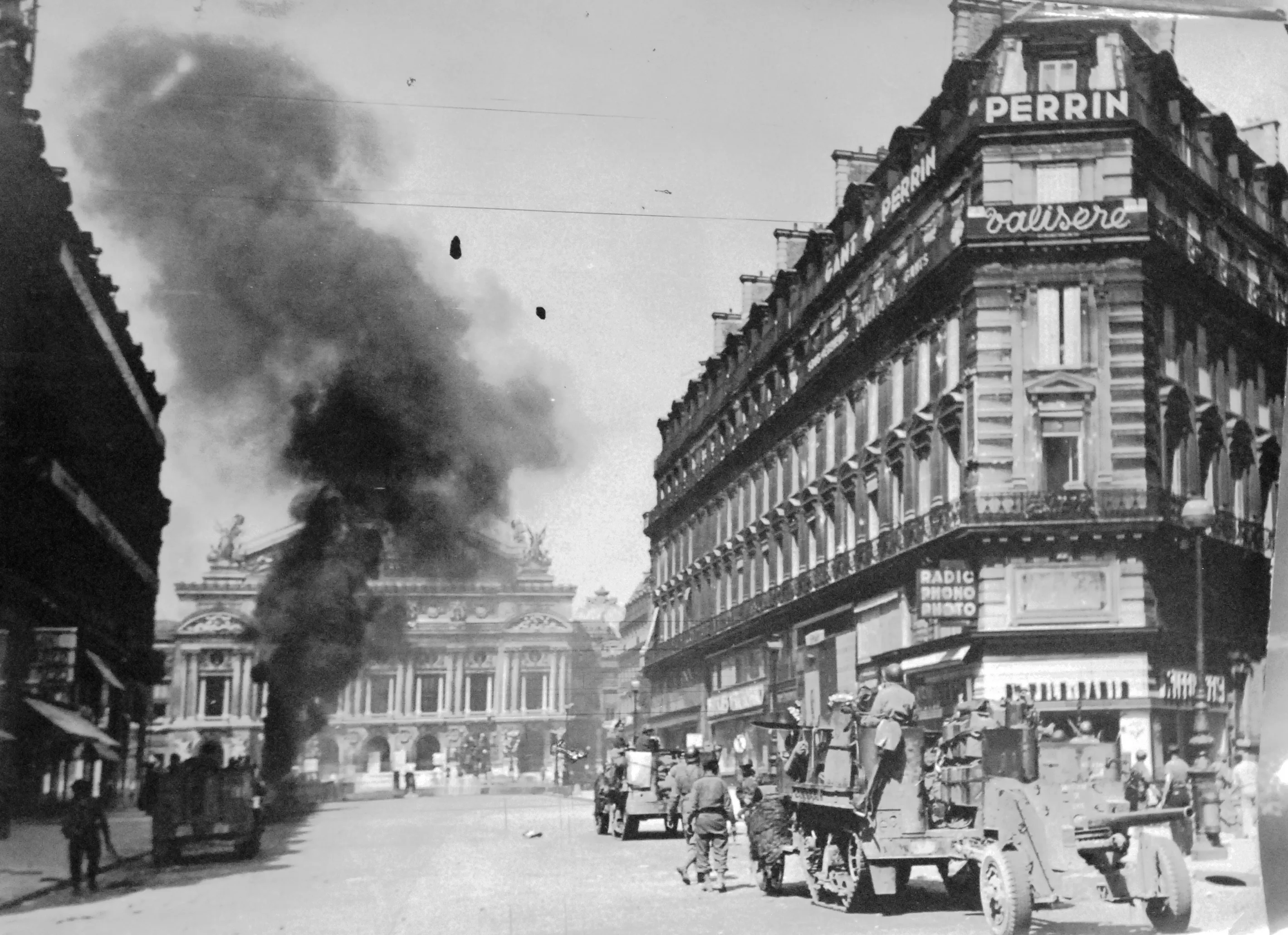
Smoke rises over Washington as British troops torch the Capitol and the President's Mansion
Washington had been undefended for weeks when British troops broke the American militia at Bladensburg on the afternoon of August 24, 1814, and marched into the capital by evening. Under Major-General Robert Ross and Rear-Admiral George Cockburn, soldiers set fire to the Capitol and the White House, sparing private homes on Ross's orders, while the Americans themselves had already burned much of the Navy Yard to prevent its capture. President Madison had already fled toward Maryland; his staff, including the enslaved teenager Paul Jennings, saved what silver they could carry before the British sat down to eat the dinner set for Madison's guests. A violent storm broke out within hours and doused the flames. The British left the city after roughly 26 hours.
Washington's burning led directly to the rebuilding of the Capitol and White House, and it hardened public opinion against the war's Federalist critics, who had opposed the conflict from the start. It also produced one of the enslaved household's few first-person records of the era: Paul Jennings' account of that night remains a rare eyewitness testimony from inside the White House itself, predating any published slave narrative.
The Daily Record · free by email
Tomorrow's edition in your inbox — one story, one quote, the flag.
1942military
Saratoga's bombers catch the Ryūjō; the carrier goes down after dark
By late August 1942, U.S. Marines had held Guadalcanal for two and a half weeks, and Japan was moving a carrier force south to break the American grip on it. On August 24, dive bombers and torpedo planes launched from USS Saratoga found the light carrier Ryūjō near Santa Isabel Island and hit her with three to five bombs and possibly a torpedo. She burned through the afternoon and sank that night. Destroyers Amatsukaze and Tokitsukaze pulled survivors from the water, along with aircrews from Ryūjō's returning strike force who ditched nearby.
Saratoga's strike proved American carrier aviation could find and kill a Japanese flattop in open water, a sign that American carrier aviation could locate and destroy Japanese carriers just weeks after Coral Sea and Midway. The battle also cost Japan aircrews it could not easily replace, buying the Marines on Guadalcanal time to finish Henderson Field.
Did you know
QWhy did Japan send its smallest carrier ahead of the main fleet?
The Ryūjō was detached from Vice Admiral Chūichi Nagumo's main carrier force, which still held the larger Shōkaku and Zuikaku, to strike Henderson Field on Guadalcanal. The mission reportedly grew out of a request from Nishizō Tsukahara, the Japanese naval commander at Rabaul, who wanted the American airstrip neutralized ahead of the fleet's arrival. That detachment left the light carrier exposed, without the heavier air cover the rest of the force carried, when American search planes came looking.
QHow did a Japanese scout plane's sighting time line up with the American strike?
At 14:25, almost simultaneously with events unfolding elsewhere in the battle, a Japanese scout aircraft launched from the cruiser Chikuma spotted the American carrier force. That sighting set the retaliatory Japanese air attack in motion within hours, the same attack that would later put three bombs into Enterprise. The near-simultaneous timing meant both fleets were closing in on each other's carriers at almost the same moment on August 24.
QWhy did Enterprise keep flying planes after being hit?
One of the three bombs that struck Enterprise punched through her flight deck and exploded below, killing 35 men. Despite that, her damage-control teams worked fast enough that the carrier resumed flight operations within an hour of being hit. The recovery stood in sharp contrast to Ryūjō's fate the same day, when fires from the American strike proved impossible to contain and she sank that night.
1949government
The North Atlantic Treaty takes effect; twelve nations are now bound to defend each other
Four months after foreign ministers signed the North Atlantic Treaty in Washington, the document became binding. On August 24, 1949, the treaty entered into force, formally establishing NATO as a functioning alliance among the United States, Canada, and ten European nations. Its core clause, Article 5, committed every member to treat an attack on one as an attack on all. It was the first peacetime military alliance the United States had joined.
The alliance marked a sharp break from the isolationist instinct that had shaped American foreign policy since Washington's Farewell Address. Article 5 bound American troops to Europe's defense before any war began, reshaping U.S. military posture in the decades that followed.
Did you know
QWhat Cold War military alliance formed in direct response to NATO's expansion?
The Warsaw Pact. When West Germany joined NATO in May 1955, the Soviet Union answered within days by organizing its own bloc of satellite states into a rival military alliance. The timing was not coincidental. Moscow had watched NATO grow from twelve founding members to a bloc that now included a rearmed West Germany, just a decade after the Wehrmacht's defeat, and responded by formalizing the command structure it already exercised informally over Eastern Europe. The two alliances would face each other across the Iron Curtain for the next thirty-four years, each treating the other's existence as justification for its own. NATO had taken six years to build an integrated command; the Warsaw Pact took days to organize on paper.
QWhich two countries joined NATO before West Germany, breaking the original European lineup entirely?
Greece and Turkey, both admitted in 1952, three years before West Germany's accession reshaped the alliance further. Neither had been part of the original twelve signatories in Washington, and neither fit the North Atlantic geography the treaty's name implied. Their inclusion extended NATO's defensive line into the eastern Mediterranean, a region the original 1949 drafters had not centered in their planning. Greece and Turkey's entry extended NATO's defensive line far outside the Atlantic basin the treaty's name implied. By the time West Germany entered in 1955, NATO had already stretched once to absorb strategic necessity over founding geography.
QWhat building blocks, older than the treaty itself, actually shaped NATO's legal architecture?
The 1941 Atlantic Charter between Franklin Roosevelt and Winston Churchill, followed by the 1947 Treaty of Dunkirk between France and Britain, and then the 1948 Treaty of Brussels, which bound France, Britain, and the Benelux countries into a mutual defense pact called the Western Union. NATO built on collective defense structures that already existed in three earlier treaties. The Western Union's military plans and command structure influenced NATO's own integrated structure when it was built in 1951. The 1949 treaty built directly on the Atlantic Charter, the Treaty of Dunkirk, and the Treaty of Brussels that came before it.