Reading 3 of 7 free1776 Club · all 7 storiesThursday, August 27
From the desk
Start with 1776: William Howe found an unguarded gap called Jamaica Pass, swung his army around Washington's left, and hit Brooklyn Heights from behind. The raw Continental Army broke, and Long Island became the war's biggest battle and worst defeat yet. Worth a longer look: Edwin Drake's drill hit a crevice at 69.5 feet in 1859, and his driller went home that night not knowing he'd started an industry. Black Hawk's 1832 surrender, taken by a young Lieutenant Jefferson Davis, closes out the day's quieter reckonings.
— The Patriot Compass desk
1776Featured · This day in history
Howe crushes Washington's army on Long Island; Brooklyn Heights now under siege
New York Harbor was the prize, and General William Howe had spent the summer massing troops on Staten Island to take it. On August 27, 1776, his army swung around the American left through an unguarded gap called Jamaica Pass and fell on Washington's positions from behind. The Continental Army, still raw and thinly spread along Brooklyn Heights, broke under the surprise attack, and the collapse made Long Island the largest battle of the Revolutionary War and its heaviest single defeat so far.
This was the first time an American army fought the British at full scale, and the defeat left thousands of Washington's men trapped against the East River with capture imminent. Washington's men learned, at cost, what it meant to face European regulars in open ground. After Long Island, Washington avoided pitched battles where his whole army could be trapped at once.
Did you know
QHow many prisoners did the British take at Long Island, including generals?
British and Hessian forces captured two American generals in the collapse: John Sullivan and William Alexander (known as Lord Stirling), who was noted for personally charging a Hessian regiment to buy time for his men to escape through the marshes, an act that cost his own freedom but let part of his brigade slip away. Both generals were eventually exchanged.
QWhere exactly did the British land before the battle began?
Howe's invasion force crossed from Staten Island in an amphibious landing onto Long Island days before the fighting, putting roughly twenty thousand men ashore, an operation the British carried out largely unopposed. That landing gave Howe time to scout the terrain and locate the gap at Jamaica Pass that decided the battle. The scale of the landing alone made Long Island the largest single deployment of troops seen in North America up to that point.
QWhat did Washington order his troops to do with New York's civilians before the fighting started?
Back in April, months before a shot was fired, Washington issued orders that his soldiers treat local civilians and their property with respect while the army built fortifications around the city. It was an unusual instruction for a force expecting siege and battle, showing Washington's early concern about keeping the population's trust.
The Daily Record · free by email
Tomorrow's edition in your inbox — one story, one quote, the flag.
1859innovation
The crevice gives way, and Drake's drill strikes oil at 69.5 feet
For sixteen months, Edwin Drake had drilled on a small island in Oil Creek while locals jeered and called the project Drake's Folly. On August 27, 1859, his drill bit reached 69.5 feet and struck a crevice in the bedrock. Drake's driller, Billy Smith, went home for the night not knowing oil was rising behind him. The well soon produced 25 barrels a day, though Drake did not yet know he had started an American industry.
Drake's well launched the first oil boom in American history, and within a day drillers up and down Oil Creek were copying his methods. Boomtowns quickly appeared, turning rural Pennsylvania into the center of the country's new oil economy. The drive pipe that kept his borehole from collapsing became standard practice for oil drillers across the country.
1962exploration
Mariner 2 lifts off for Venus, five weeks after its twin veered into the Atlantic
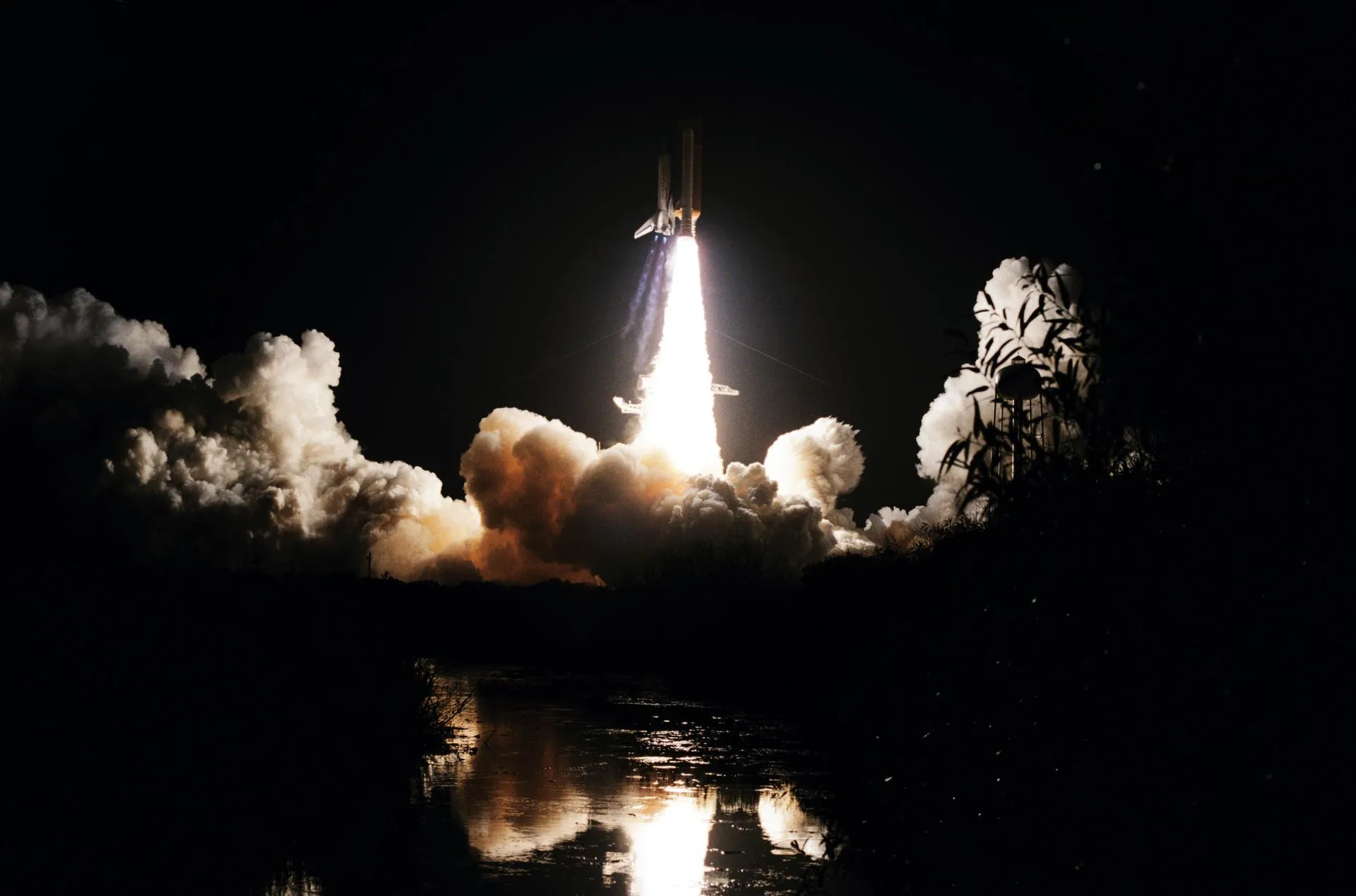
Five weeks earlier, on July 22, Mariner 1 had veered off course and been blown up by a range safety officer; a missing hyphen in its guidance code was later blamed for the failure. At 1:53 a.m. Eastern on August 27, 1962, its twin, Mariner 2, rode an Atlas-Agena B rocket off Launch Complex 12 at Cape Canaveral. Within 44 minutes its solar panels had unfolded; about 18 minutes later, its Sun sensor locked onto the Sun. The spacecraft was now bound for Venus.
Mariner 2 gave the United States its first working interplanetary spacecraft at the height of the space race, JPL recovered from a public failure and reached another planet before the Soviets did. The mission's radiometer data, showing Venus's cloud tops were cool but its surface scorching, gave American planetary scientists the evidence they cited for the rest of the decade to rule out Venus as Earth's twin.
Did you know
QWhy did NASA end up launching Mariner on the smaller Agena B instead of the rocket it was designed for?
Mariner was originally planned for the Atlas-Centaur, a rocket with far more lifting power, but the Centaur upper stage ran into serious development trouble on its own schedule. Rather than wait, NASA and JPL redesigned the mission around the smaller, already-flying Agena B second stage. That forced engineers to shrink and simplify the spacecraft, folding Mariner's design into a hybrid of the shelved Mariner A concept and JPL's Block 1 Ranger lunar probe, built in an eleven-month sprint. The substitution shaped the entire spacecraft's tight weight budget.
QHow precisely did engineers hit the spacecraft's target weight?
Mariner 2 weighed in within 3 pounds of its design target of 447 pounds, a margin of just over half a percent on a spacecraft assembled in under a year. Of that weight, 406 pounds went to non-experimental systems alone: fuel, maneuvering hardware, and the radio equipment needed to receive commands and transmit data back to Earth. The remaining weight covered every scientific instrument the mission carried, leaving JPL's engineers little room to work with once the rocket switch shrank the whole design.
QWhat kept Mariner 2's onboard computer from cooking itself during the flight?
The spacecraft relied on two separate systems to survive the temperature swings of deep space: passive protection from insulated, highly reflective surfaces, and active protection from a set of louvers built specifically to shield the case housing the onboard computer. The louvers opened and closed automatically as temperatures shifted. Without the louvers, the onboard computer running Mariner 2's automated sequences could have overheated before the spacecraft reached Venus.