Reading 3 of 6 free1776 Club · all 6 storiesFriday, August 28
From the desk
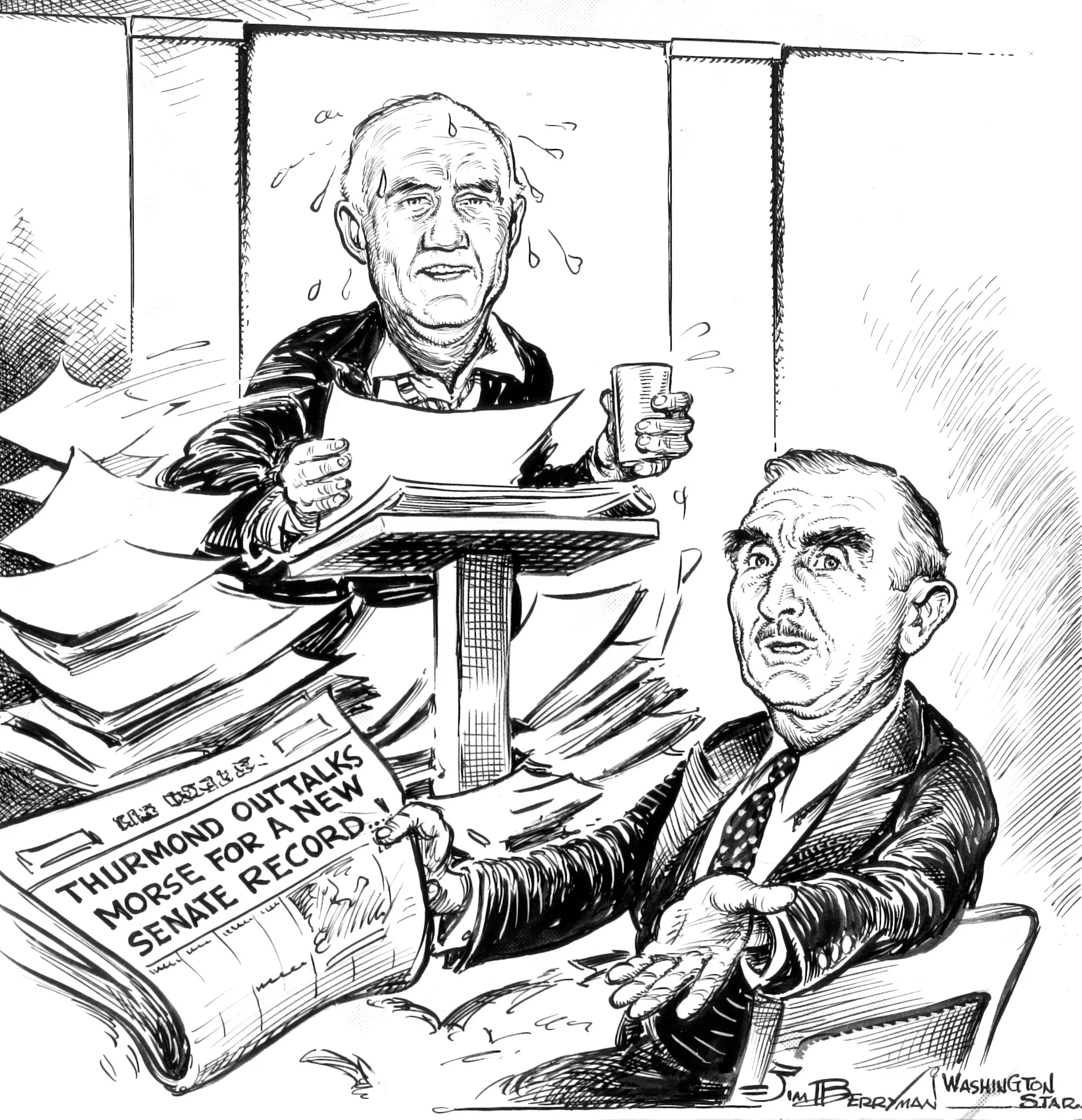
Start with 1963. King had put his written text aside and was closing when Mahalia Jackson, off to the side, called out "Tell them about the dream, Martin," and he did, building "I Have a Dream" live in front of 250,000 people. Worth a longer look: 1957, when Strom Thurmond broke a truce among his own Southern colleagues to filibuster the civil rights bill alone for 24 hours and 18 minutes, reading George Washington's Farewell Address to run out the clock. Same fight, two Augusts apart, opposite ends of it.
— The Patriot Compass desk
1963Featured · This day in history
Two hundred fifty thousand hear King say he has a dream, from the steps of the Lincoln Memorial
By the summer of 1963, President Kennedy's civil rights bill was stalled in Congress, and organizers planned a march on the capital to force the issue. On August 28, Martin Luther King Jr. addressed more than 250,000 people from the Lincoln Memorial, invoking the Emancipation Proclamation and the Declaration of Independence. Partway through, with his written remarks behind him, he built to an improvised close on a theme he had preached before: "I have a dream." Newspapers the next morning called it the best-covered event in Washington since Kennedy's inauguration.
Lincoln Memorial, Washington, District of ColumbiaStory page →
The American Throughline
The speech turned public pressure on a stalled bill into political momentum; within a year, Congress passed the Civil Rights Act of 1964. It also reset the American vocabulary for equality, folding the Declaration of Independence and Lincoln's proclamation into a single argument that still anchors how the country talks about its founding promises.
Did you know
QHow long had King been using the "I have a dream" phrase before this speech made it famous?
King had been preaching on the theme of dreams since 1960, three years before the March on Washington, testing versions of the phrase in churches and smaller rallies. By the time he reached the Lincoln Memorial in 1963, it was a rehearsed riff rather than a spontaneous invention, which is part of why he could reach for it so fluidly once he set his prepared text aside. The public simply had not heard it on this scale before.
QWhat line did King borrow from an English king rather than an American document?
Near the close of the speech, King reached past American sources entirely, alluding to the opening lines of Shakespeare's Richard III alongside a reference to Galatians 3:28. It is an unexpected pairing inside a speech otherwise built on the Declaration of Independence and the Emancipation Proclamation, and a reminder that King's rhetorical training ran through scripture and literature as much as through law.
QHow did the scholarly world eventually rank the speech against every other American speech?
In 1999, a poll of scholars of public address ranked "I Have a Dream" the top American speech of the entire twentieth century, ahead of every presidential inaugural and wartime address delivered in that hundred years. The ranking came thirty-six years after King spoke, long after the improvised ending had become the only part most Americans could quote from memory.
The Daily Record · free by email
Tomorrow's edition in your inbox — one story, one quote, the flag.
1861military
Union guns open on Hatteras Inlet; the forts guarding it cannot answer
Four months after Fort Sumter, the Union navy turned its attention to the Outer Banks, where Confederate forts guarded a gap in North Carolina's barrier islands used by blockade runners. On August 28, 1861, Union warships opened fire on Forts Hatteras and Clark at Hatteras Inlet, standing offshore beyond the range of the forts' own guns. The bombardment continued into a second day before the Confederate garrison surrendered. It was the Union's first captured ground in a seceded state.
Hatteras Inlet was the Union's first captured Confederate territory of the war, and it showed the blockade strategy could work: ships standing off past a fort's range pounded it into submission, and the Union lost no men to a land assault. The victory came after the defeat at Bull Run weeks earlier, and Northern newspapers played it up. It also gave the Union a base for tightening its blockade of Confederate shipping.
Did you know
QWhy is the stretch of coast around Hatteras Inlet called the 'Graveyard of the Atlantic'?
The waters off Cape Hatteras have claimed so many ships over the centuries that sailors nicknamed the area the Graveyard of the Atlantic. Shifting sandbars like Diamond Shoals, turbulent seas, and a coastline that juts far into the Atlantic combine to wreck vessels with regularity. The Outer Banks sit exposed to the open ocean with little natural shelter, and the same shoals that sank merchant ships and naval vessels for generations gave the Confederate forts at the inlet almost no protected anchorage of their own. Any fleet operating there, Union or Confederate, had to contend with a coastline nearly as dangerous as the enemy's guns.
QHow exposed was Cape Hatteras to nature's own artillery during the Civil War years?
The Outer Banks sat directly in the path of Atlantic hurricanes and tropical storms, a fact that weighed on military decisions made there. The barrier islands themselves are constantly reshaped by wind, waves, and storm surge, built from long stretches of beach, shifting sand dunes, and marshes that could flood or erode with a single strong storm. A garrison stationed there was effectively camped on ground the ocean itself was still rearranging. That instability made permanent fortification difficult, and defenders faced both bombardment and a shifting landscape.
QWhat kind of terrain surrounded the forts beyond the beach itself?
Behind the dunes and open beach at Hatteras Inlet lay maritime forests and marshland, a mix of terrain unusual for a coastal battlefield. These maritime forests grow low and wind-bent close to the barrier islands, stunted by salt spray and storms, while the marshes behind them are cut through with tidal creeks. This mix of sand, forest, and marsh gave blockade runners cover as they slipped between the open ocean and North Carolina's sounds.
1898innovation
New Bern druggist drops "Brad's Drink" for a new name: Pepsi-Cola
For nearly five years, customers at Bradham's Drug Store in New Bern, North Carolina, had known the fizzy blend of kola nut extract, vanilla, and rare oils simply as "Brad's Drink." On August 28, 1898, pharmacist Caleb Bradham gave it a new name: Pepsi-Cola, drawing on the terms pepsin and cola to echo his claim that the drink settled the stomach. The soda fountain drink now had a name built to sell.
A small-town North Carolina drugstore remedy became one of the soft drinks that would come to define American consumer culture for the next century. Bradham's decision to name his product after a digestive claim, rather than a place or his own name, reflected an approach many American brands would later copy: naming a product for what it promised to do.
Did you know
QWhat exactly did 1902 advertisements promise a glass of Pepsi-Cola would do for you?
Early print ads carried the subtitle "The Pepsin Drink" and claimed the beverage could relieve indigestion, headaches, and drowsiness. A 1902 advertisement went further, telling readers that a single glass of Pepsi-Cola contained a full teaspoon's worth of the pepsin concoction Bradham had mixed up. Modern writers dispute whether actual pepsin was ever in the formula, but the marketing leaned hard on the medicinal claim regardless. The name did exactly what Bradham wanted: it sold a cure, not just a drink. A drugstore soda was being pitched with the specificity of a prescription label, teaspoon measurement included.
QWhy did a sugar bet destroy the company Bradham built, decades after he coined the name?
Pepsi-Cola Company went bankrupt on May 31, 1923, not from weak sales but from a speculative gamble on sugar prices after World War I. Bradham had wagered on where sugar costs would move as the postwar economy settled, and the bet went badly wrong. The company's assets were liquidated for just $30,000, a fraction of what the name would later be worth, before new owners bought the wreckage and reformulated the drink. Bradham lost the company he built on a digestive pun after the sugar bet failed. Pepsi-Cola outlived its founder's ownership by decades under entirely different management.
QWho was the very first person to taste the formula that became Pepsi-Cola?
Before there was a name, a company, or a bottle, there was James Henry King, Bradham's assistant at the drugstore, who tasted the untitled mix of kola nut extract, vanilla, and rare oils in 1893. His reaction went unrecorded, but the formula stuck around the soda fountain for five years afterward under the plain name "Brad's Drink" before Bradham ever thought to rebrand it. King's sip predates the Pepsi name by half a decade. King's sip happened behind a drugstore counter, with no ceremony attached.