Reading 3 of 6 free1776 Club · all 6 storiesThursday, September 3
From the desk
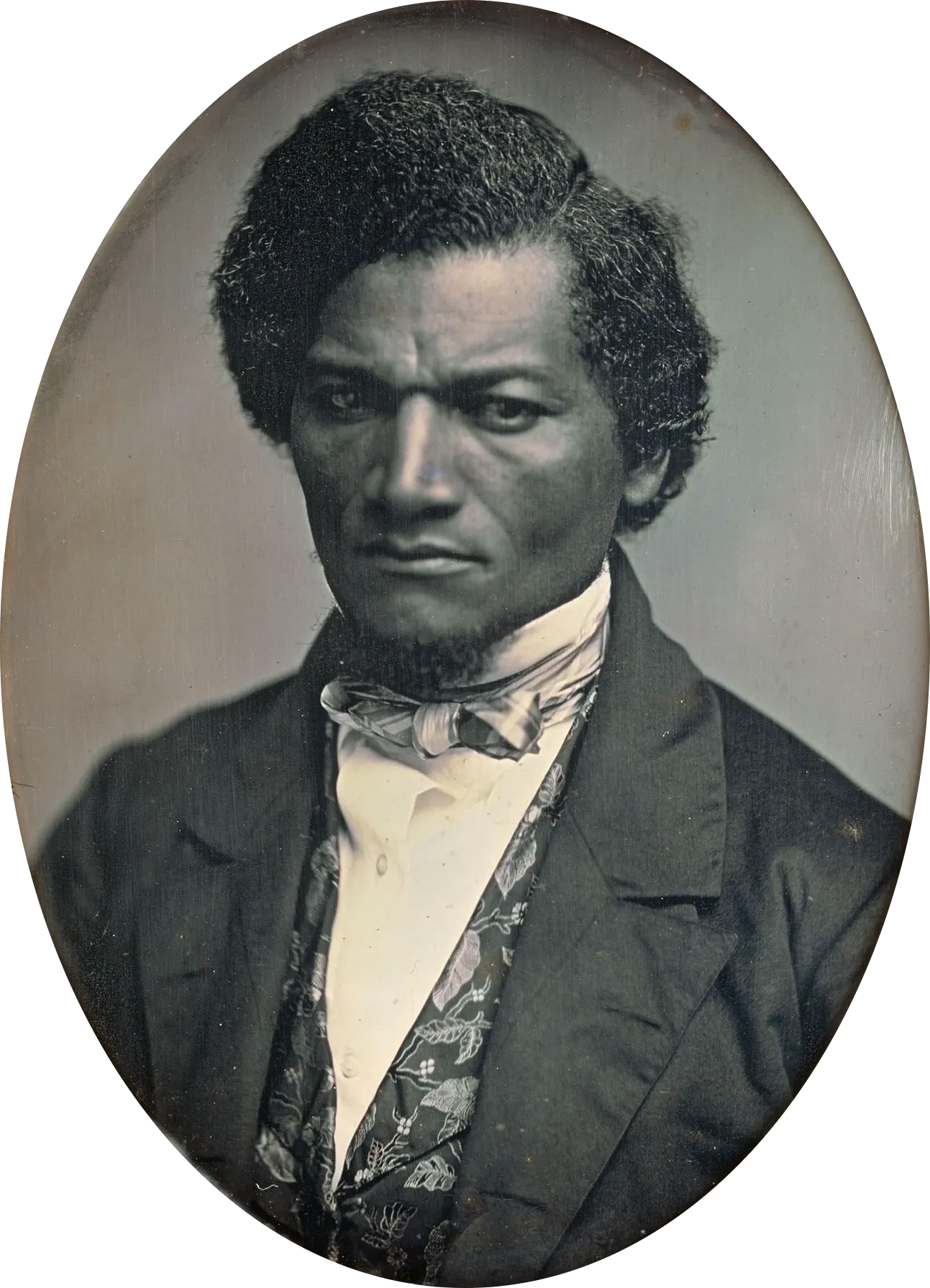
Start with 1783: it took two years after Yorktown for the war to end on paper, and on September 3 that year, Franklin, Adams, and Jay signed the Treaty of Paris at the Hôtel d'York, winning the new nation everything between the Mississippi, Canada, and Florida. Worth a longer look is Frederick Douglass in 1838, borrowed papers and a sailor's disguise carrying him from Baltimore's docks to New York in under 24 hours. Cooch's Bridge fills out the day, a two-mile running fight some call the first battle under the Stars and Stripes.
— The Patriot Compass desk
1783Featured · This day in history
Peace is signed at the Hôtel d'York; the United States is free and independent
For two years after Yorktown, the war that had already been won on the battlefield still needed to be won on paper. On September 3, 1783, John Adams, Benjamin Franklin, and John Jay signed the Treaty of Paris on behalf of the United States, meeting British negotiator David Hartley at the Hôtel d'York on Paris's Rue Jacob. The treaty gave the new nation the land between the Mississippi, Canada, and Florida, along with fishing rights off Newfoundland. In the treaty, Britain recognized the thirteen colonies as free and independent states.
The treaty's Article 1, the only clause still legally in force, is the founding document of American sovereignty itself: Britain's plain acknowledgment that the states were free and independent. The boundaries it drew, however clumsily, set the template for the westward expansion of the next century.
Did you know
QWho actually delivered the British side of the negotiations before the final signing?
Richard Oswald was one of Lord Shelburne's negotiators alongside David Hartley representing Great Britain during the 1782 talks, before Hartley signed the finished treaty in September 1783. Oswald had personal ties to America going back to prewar business dealings, which Shelburne believed would make him sympathetic and effective at the table. He helped shape the generous boundary terms long before Hartley ever picked up a pen.
QWhat specific fishing grounds did the treaty hand the United States, beyond the coastal waters everyone assumes?
American negotiators secured rights not just off Nova Scotia but in the Grand Banks off Newfoundland and in the Gulf of Saint Lawrence, some of the richest cod fisheries in the Atlantic world. New England's fishing fleets had worked those waters for generations under British protection, and losing access would have gutted a major colonial industry. The treaty's fisheries clause preserved an economic lifeline that had nothing to do with land at all.
QWhat was the address where the treaty was actually signed?
The signing took place at the Hôtel d'York, a Parisian lodging house at what is now 56 Rue Jacob on the Left Bank, chosen simply because it was where the American delegation was staying rather than for any ceremonial reason. There was no grand hall or formal chamber involved. Four men signed the document in a rented room on a residential street, and the building still stands there today.
The Daily Record · free by email
Tomorrow's edition in your inbox — one story, one quote, the flag.
1976exploration
Viking 2 sets down on Mars, tilted on a rock at Utopia Planitia
By the summer of 1976, NASA had Viking 1 working on the ground and Viking 2 still circling overhead, hunting for a safe place to put down. On September 3, 1976, Viking 2 separated from its orbiter and descended to Utopia Planitia, a vast plain inside Mars's largest impact basin, touching down at 22:58:20 UT with one leg resting on a rock and the craft tilted 8.2 degrees. A misread radar signal had fired the landing thrusters an extra time just 0.4 seconds before contact, cracking the surface and kicking up dust. The cameras had already started sending back pictures.
Viking 2 gave the United States a second working laboratory on another planet, roughly 4,000 miles from its twin, giving NASA's biology experiments a second Martian site to test. The lander kept transmitting from Utopia Planitia for about three years and seven months, and its data remained the primary American record of Mars until rover missions arrived in the late 1990s.
Did you know
QWhat was actually in the Martian soil that Viking 2 scooped up at Utopia Planitia?
The soil resembled weathered basaltic lava, dominated by silicon and iron with notable amounts of magnesium, aluminum, sulfur, calcium, and titanium. That chemical fingerprint told scientists the ground under Viking 2 had formed from volcanic rock broken down over ages of exposure, similar to volcanic soils found on Earth. The reading became part of the baseline data on Martian geology until rover missions arrived in the late 1990s and sampled new sites directly. The sulfur and calcium levels later fed into broader debates about oxidizing chemicals in Martian dirt, chemistry that some scientists eventually pointed to as a possible explanation for the lander's puzzling biology results.
QWhy did Viking 2's orbiter need a last-minute course correction after the lander departed?
The bioshield, a protective cover meant to detach once the lander separated, malfunctioned and stayed stuck to the orbiter instead of falling away as planned. Engineers had to compensate by raising the orbiter's orbit inclination to 75 degrees on September 30, 1976, adjusting its path to keep the mission on track despite the stuck hardware. The orbiter went on to complete 706 orbits and beam back nearly 16,000 images before its own operations ended on July 25, 1978. A hardware glitch during separation, in other words, forced a mid-course fix that had nothing to do with the lander's own dramatic touchdown.
QHow much did Viking 2 weigh by the time it actually reached the Martian surface?
The lander tipped the scales at about 600 kilograms once it touched down, a figure already reduced from its launch weight after burning through rocket propellant during descent. Roughly 22 kilograms of that propellant remained unused in the tanks at the moment of landing, fuel that would have been available for maneuvering had the descent required it. The craft had traveled sterilized inside an aeroshell heat shield the whole way from Cape Canaveral, a precaution taken specifically to keep Earth organisms from contaminating Mars. That mass had survived a year of spaceflight and a fiery atmospheric entry.
1777military
Musket fire greets Hessian dragoons at Cooch's Bridge; some say the Stars and Stripes flew over the fight
Howe's army was pushing north from the Chesapeake toward Philadelphia, and Washington had sent a light infantry corps of seven hundred picked Continental infantrymen, joined by about a thousand Pennsylvania and Delaware militia, under Brigadier General William Maxwell to slow him down. Near Thomas Cooch's bridge on the morning of September 3, 1777, Hessian dragoons riding at the head of the British column rode into an American ambush in the woods along the road. The skirmish spread for nearly two miles and lasted most of the day before Maxwell's men, out of ammunition, gave ground across the bridge. Some accounts hold that the flag carried into that fight was the first appearance of the Stars and Stripes in battle.
If the tradition is accurate, this stretch of Delaware woodland is where the American flag first flew under fire. Congress had approved the Stars and Stripes design barely two months earlier, on June 14, 1777, and Cooch's Bridge gave that new emblem its first battlefield test before it reached the battles Americans would later remember by name.
Did you know
QWhat did a foreign officer serving in the Prussian army say about Maxwell's leadership?
A foreign officer with prior service in the Army of Prussia wrote to Henry Laurens with a backhanded compliment about William Maxwell's brigade: "Your soldiers are very good men, so good as any brave men in the world, but your officers my dear colonel, your officers..." The line trailed off deliberately, and it captured a broader criticism Maxwell faced from several of Washington's subordinates in the aftermath of the fight. The quote praised the rank and file while leaving little doubt he blamed the officers. Maxwell's command decisions at Cooch's Bridge remained a point of contention among American officers for some time afterward.
QHow did British and American casualty counts diverge from each other beyond the death toll?
British estimates of their own losses varied wildly, ranging from as few as 3 killed and 20 wounded up to about 30 killed or wounded total, a discrepancy of ten times between the low and high figures. Washington told Congress the fight came after the enemy advanced with "considerable force and three pieces of Artillery" against his light corps, and that the Americans withdrew only because they were outnumbered and had no cannon of their own. That detail about British artillery never appears in most retellings of the skirmish. The uncertainty over British losses stands in contrast to the far more specific, and disputed, count of American dead that both sides argued over afterward.
QWhat honor did Glasgow High School give this obscure Delaware skirmish decades later?
The school adopted the battle as its official coat of arms, depicting Continental soldiers locked in combat with British troops beneath a flying Betsy Ross flag. It is a rare case of a single day's fighting, remembered by almost no one outside Delaware, becoming permanent heraldry for a public school. The site itself later drew similar long-term attention: in 2003 the Cooch family sold land and development rights to the state to keep the battlefield from being paved over, and in 2007 reenactors gathered to mark the 230th anniversary. Together these gestures kept the battle alive in local memory through crests, preserved fields, and staged musket fire.