Reading 3 of 6 free1776 Club · all 6 storiesSunday, September 6
From the desk
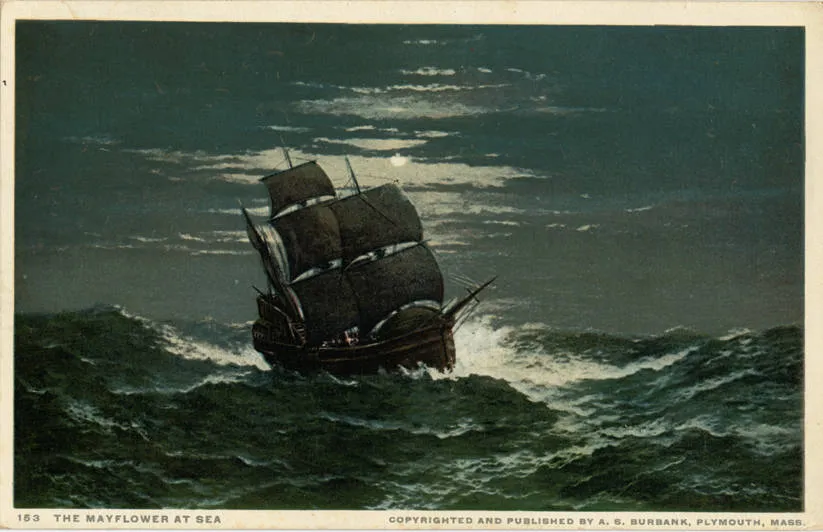
Start with 1901: a president who liked to shake every hand he could reach, an anarchist with a revolver hidden in a handkerchief, and McKinley, bleeding, asking the crowd to spare the man who shot him. He'd be dead in eight days. Worth a longer look: 1870, when 69-year-old Louisa Swain walked into Laramie with a tin pail of yeast and cast the first legal ballot by a woman in over sixty years, ahead of ninety-one others that same morning. Also worth a glance: the Mayflower, sailing alone in 1620 after her leaking sister ship gave out.
— The Patriot Compass desk
1901Featured · This day in history
McKinley shot twice at point-blank range in a Buffalo music hall
President William McKinley spent the afternoon of September 6, 1901, shaking hands with strangers, this time in the Temple of Music at Buffalo's Pan-American Exposition. Leon Czolgosz, an anarchist carrying a revolver wrapped in a handkerchief, slapped aside McKinley's outstretched hand and fired twice into his abdomen. Bystander James Parker struck Czolgosz in the neck and knocked the gun from his hand before he could fire a third shot, and a bleeding McKinley told the crowd beating his attacker, "Go easy on him, boys." The wounds turned gangrenous; McKinley died eight days later.
Temple of Music, Pan-American Exposition, Buffalo, New YorkStory page →
The American Throughline
McKinley's death made Theodore Roosevelt president at forty-two. It also pushed Congress to give the Secret Service formal, permanent responsibility for guarding the president. Presidential receiving lines like McKinley's largely disappeared afterward; security now screens the public before any president gets close.
Did you know
QWhat actually stopped the first bullet from doing worse damage to McKinley?
A coat button. As Czolgosz fired twice at point-blank range, the first bullet struck one of the buttons on McKinley's jacket and ricocheted away, lodging harmlessly in the fabric instead of his body. The second shot had no such luck, piercing his stomach and, unlike the first, was never recovered by surgeons. That stray piece of tailoring meant the first bullet never reached him at all; the second, unstopped, caused the fatal wound. A button, not a guard, was the only thing standing between McKinley and a worse wound that day.
QWhat did the Secret Service agent assigned to McKinley do to Czolgosz after the shots were fired?
George Foster, McKinley's regular Secret Service agent, physically struck Czolgosz to the ground while searching him after the shooting. Foster's anger reportedly flared because Czolgosz kept twisting his head around to keep watching the wounded president rather than staying still, and Foster knocked him down for it. This happened amid the chaos of onlookers and police already beating Czolgosz following James Parker's intervention. Foster's blow was a small footnote next to the larger scramble around Czolgosz.
QWhat happened to Czolgosz's body after his execution to make sure nothing of him survived?
Prison officials doused his coffin in sulfuric acid before burial on the prison grounds, deliberately disfiguring his remains beyond recognition. Before that, his brain had already been removed and examined by scientist Edward Anthony Spitzka, part of an effort to search his anatomy for some physical explanation of his crime. There was no headstone, no marked grave anyone could visit, and no physical trace left intact. No headstone marked the spot, and no trace of him remained.
The Daily Record · free by email
Tomorrow's edition in your inbox — one story, one quote, the flag.
1870civil-rights
A 69-year-old grandmother votes in Laramie; no American woman has voted legally in 63 years
Wyoming Territory had written women's suffrage into law the year before, an experiment no other American government had tried since New Jersey briefly allowed it and then took it back in 1807. On the morning of September 6, 1870, Louisa Ann Swain, 69, walked into Laramie carrying a tin pail she'd filled with yeast at the merchant's, and cast her ballot before the polls had drawn much of a crowd. Ninety-two Wyoming women voted that day. Swain, most accounts agree, was first.
Swain's ballot gave the suffrage movement its first working proof that women could vote without incident in a general election. Wyoming rode that precedent into statehood in 1890 as the first state where women voted on equal terms with men, and the territory's 1869 law became the model suffragists cited for the next fifty years.
Did you know
QHow many other women voted alongside Swain that same day in Wyoming?
Ninety-two women cast ballots in Wyoming Territory on September 6, 1870, the same day as Swain. The territorial legislature had passed the suffrage law in December 1869, so the election was the first real test of whether the experiment would work in practice, not just on paper. No court challenge or crisis followed. Ninety-two quiet ballots became evidence suffragists across the country cited for years whenever someone claimed women voting would bring disorder.
QWho else voted in Laramie that morning besides Swain?
Augusta C. Howe voted roughly thirty minutes after Swain. She was married to Church Howe, the U.S. Marshal for Wyoming Territory, which meant the second woman to vote legally in America after 1807 was married to a federal law enforcement officer. Her name rarely makes the headlines Swain's does, but she voted at the same polling place that same morning, one of ninety-two Wyoming women who cast ballots that day.
QWhat building carries Swain's name today, and where is it?
In 2022, Congress designated the federal office building at 308 W. 21st Street in Cheyenne, Wyoming, the Louisa Swain Federal Office Building. It sits in the territorial and later state capital, more than a century and a half after the vote it commemorates took place about fifty miles away in Laramie. The naming came fourteen years after Congress had already set aside September 6, 2008, as Louisa Swain Day through House Concurrent Resolution 378, a naming that came fourteen years after the day was first set aside, for a woman who left Wyoming for good within a couple of years of making it famous.
2013exploration
A rocket built from retired nukes lifts a moon probe off Wallops Island
For years, lunar missions had launched from Cape Canaveral or Kennedy Space Center, never from the quiet spaceport on Virginia's Eastern Shore. On the night of September 6, 2013, at 11:27 p.m., a five-stage Minotaur V rocket rose from the Mid-Atlantic Regional Spaceport on Wallops Island carrying NASA's LADEE spacecraft. Clear skies let observers as far away as Maine and South Carolina watch the ascent and staging. It was the first lunar mission ever launched from Wallops.
Minotaur V used decommissioned LGM-118 Peacekeeper missiles as the lower stages of a NASA launch vehicle for lunar science. The mission also proved a second American spaceport, run jointly by NASA and Virginia, could send a spacecraft to the moon, the first time a lunar mission launched from anywhere other than Kennedy Space Center.
Did you know
QHow far apart were LADEE and Earth when its laser system set a data transmission record?
The Lunar Laser Communication Demonstration beamed data across 385,000 kilometers, roughly 239,000 miles, linking the orbiting spacecraft to a ground station on Earth. The test ran on October 18, 2013, about two weeks after LADEE settled into lunar orbit. The instrument was a pulsed laser system, a technology distinct from the radio links NASA had relied on for decades of deep space communication. It shared the mission with three science instruments built to study the moon's thin atmosphere and dust. The laser test set a record for data transmitted from lunar orbit to Earth.
QWhat was neon doing in the moon's atmosphere, according to LADEE's instruments?
LADEE's Neutral Mass Spectrometer detected neon in the lunar exosphere, confirming the presence of a gas scientists had suspected but never directly measured there. The spacecraft's science payload also included a UV-Vis Spectrometer and the Lunar Dust EXperiment, both built to characterize the thin haze of gas and dust clinging to the moon's surface. NASA Ames Research Center handled LADEE's daily operations while Goddard Space Flight Center ran the sensor suite. The neon finding was one of several direct measurements LADEE made of the lunar exosphere.
QWhat did LADEE's dust readings end up helping track after a foreign spacecraft landed on the moon?
Data from LADEE's dust instrument was later used to track exhaust and dust kicked up by China's Chang'e 3 lunar lander, giving scientists a way to measure how debris from a landing spreads and settles in the moon's near-vacuum environment. That secondary use came after LADEE's primary seven-month mission studying the lunar exosphere and dust environment around the equator. LADEE also earned a 2014 Popular Mechanics Breakthrough Award for that dust-tracking work. LADEE cost roughly $280 million total, covering spacecraft development, launch services, and mission operations, a modest price for data that ended up useful well beyond its own flight plan.