
Indiana Flag Status — Is the Flag at Half-Staff Today?
The current status could not be loaded just now. The national status is on the main flag page.
Who lowers the flag in Indiana
In Indiana, flags are lowered by the Governor and published to a state events calendar that carries flag orders alongside other official notices. That calendar format is unusual: it means an Indiana order appears with explicit start and end dates rather than as prose, which is clearer than most, though it also means flag notices sit among unrelated entries.
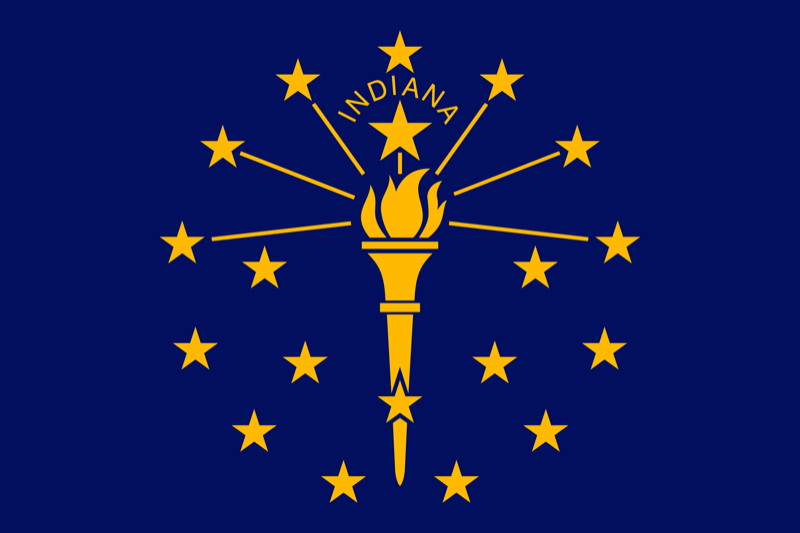
The flag of Indiana
A blue field carries a gold torch (representing liberty and enlightenment), with rays extending outward; thirteen outer stars represent the original colonies, five inner ones the next states admitted, and a single larger star marks Indiana itself.
Indiana on the American flag
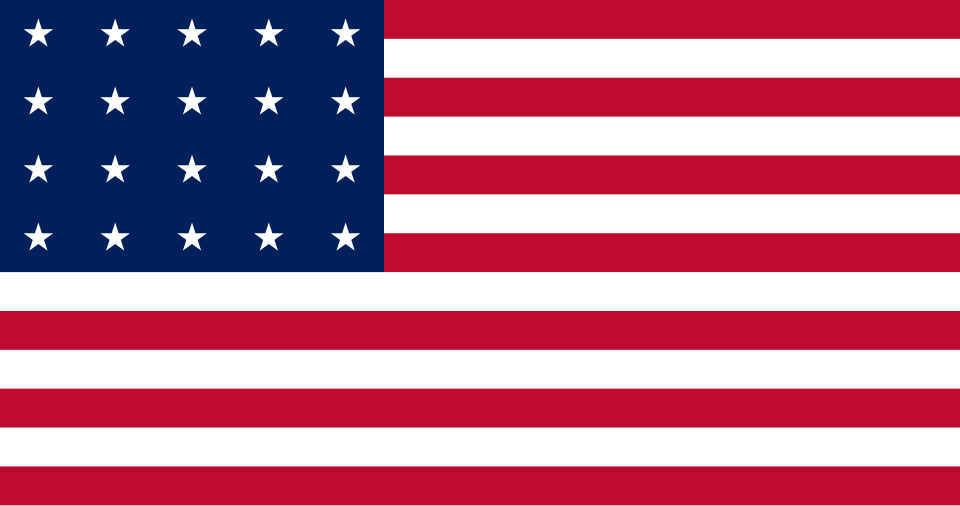
The Flag Act of 1818 returned the stripes permanently to thirteen and specified that a new star would be added on the Fourth of July following each state's admission. Twenty stars recognized the original thirteen plus Vermont, Kentucky, Tennessee, Ohio, Louisiana, Indiana, and Mississippi.
Sunrise and sunset in Indianapolis
The flag is raised at sunrise and lowered at sunset. Today at the state capital:
How Indiana became a state
Carved from the Indiana Territory, the state took its name from a Native American land company. It joined the Union on December 11, 1816 as the 19th state and became a critical north-south crossroads — its limestone built the U.S. Capitol, the Pentagon, and many other landmarks.
Admitted December 11, 1816 — the 19th state.
Indiana at a glance
Did you know
- Indiana limestone built much of the U.S. Capitol and the Pentagon.
- The Indianapolis 500 is the world’s largest single-day sporting event.
- The origin of “Hoosier” is contested but predates statehood.
- Indiana has more miles of interstate highway per square mile than any other state.
Born or raised here: Benjamin Harrison (23rd President; lived in Indianapolis) · Abraham Lincoln (raised in Indiana from age 7) · Cole Porter (composer; Peru) · James Dean (actor; Marion) · Michael Jackson (singer; Gary) · Larry Bird (basketball legend; French Lick)
Indiana in the American Record
Moments from the daily edition that happened in Indiana.
Official source
Orders are announced by the Governor’s office.
Common questions.
Is the flag at half-staff in Indiana today?+
The status above answers that for today. A national half-staff order applies in Indiana as it does everywhere else; the Governor can also lower flags within the state independently.
Who orders flags to half-staff in Indiana?+
In Indiana, flags are lowered by the Governor and published to a state events calendar that carries flag orders alongside other official notices. That calendar format is unusual: it means an Indiana order appears with explicit start and end dates rather than as prose, which is clearer than most, though it also means flag notices sit among unrelated entries.
Does a county order mean the whole of Indiana lowers its flags?+
No. A county or single-facility order (the State Capitol, for instance) applies only where it says it does. This page shows those separately from the statewide status precisely so the two are never confused — if the status above reads full-staff, Indiana has no statewide order in effect regardless of any local one.
When should the flag be raised and lowered in Indiana?+
The flag flies from sunrise to sunset. Today at the state capital, Indianapolis, those times are shown above. On the final day of a half-staff order that runs "until sunset", the flag returns to full height at the local sunset — which is why the West Coast stays lowered a few hours after the East.
Flag status for every state, and the day in American history — one page, every morning.
See the full board →