
Texas Flag Status — Is the Flag at Half-Staff Today?
The current status could not be loaded just now. The national status is on the main flag page.

Who lowers the flag in Texas
In Texas, flags are lowered by proclamation of the Governor, issued through the Office of the Governor and posted to the state’s own flag-status page. Texas is one of roughly two dozen states that maintain a dedicated flag page rather than announcing orders only through press releases, so an order’s effective dates and its scope are usually stated plainly at the source. Cities and counties set their own practice, which is why a local lowering — a county honouring a fallen deputy, for instance — may be in effect without appearing as a statewide order.
The flag of Texas
A vertical blue stripe bears a single white five-pointed star (the “Lone Star”) representing Texas as an independent state; horizontal white and red bands recall purity and bravery. Adopted as the flag of the Republic of Texas in 1839.
Texas on the American flag
Texas’s star joined the national flag on July 4, 1846 — the Fourth of July after admission, as the Flag Act of 1818 provides.
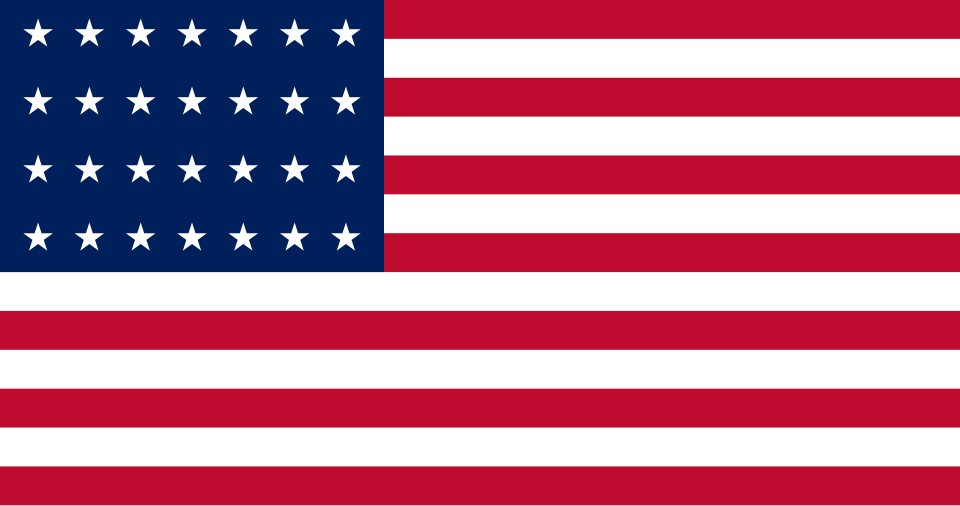
Adopted July 4, 1846, to recognize Texas. It was the flag carried into the Mexican–American War.
Sunrise and sunset in Austin
The flag is raised at sunrise and lowered at sunset. Today at the state capital:
How Texas became a state
Independent of Mexico after the 1836 revolution, the Republic of Texas operated as a sovereign nation for nine years before joining the Union by joint congressional resolution on December 29, 1845 as the 28th state. It remains the only U.S. state to have been an internationally recognized independent republic.
Admitted December 29, 1845 — the 28th state.
Texas at a glance
Did you know
- Texas is the only state that was an independent nation before joining the Union.
- It has the most farms and ranchland of any U.S. state.
- The state’s King Ranch is larger than Rhode Island.
- Texas could legally divide itself into five states under its 1845 annexation resolution.
Born or raised here: Dwight D. Eisenhower (34th President; Denison) · Lyndon B. Johnson (36th President; Stonewall) · George H.W. Bush (41st President; longtime resident) · George W. Bush (43rd President; Midland) · Buddy Holly (musician; Lubbock) · Beyoncé (singer; Houston)
Texas in the American Record
Moments from the daily edition that happened in Texas.
Official source
Orders are announced by the Governor’s office.
Common questions.
Is the flag at half-staff in Texas today?+
The status above answers that for today. A national half-staff order applies in Texas as it does everywhere else; the Governor can also lower flags within the state independently.
Who orders flags to half-staff in Texas?+
In Texas, flags are lowered by proclamation of the Governor, issued through the Office of the Governor and posted to the state’s own flag-status page. Texas is one of roughly two dozen states that maintain a dedicated flag page rather than announcing orders only through press releases, so an order’s effective dates and its scope are usually stated plainly at the source. Cities and counties set their own practice, which is why a local lowering — a county honouring a fallen deputy, for instance — may be in effect without appearing as a statewide order.
Does a county order mean the whole of Texas lowers its flags?+
No. A county or single-facility order (the State Capitol, for instance) applies only where it says it does. This page shows those separately from the statewide status precisely so the two are never confused — if the status above reads full-staff, Texas has no statewide order in effect regardless of any local one.
When should the flag be raised and lowered in Texas?+
The flag flies from sunrise to sunset. Today at the state capital, Austin, those times are shown above. On the final day of a half-staff order that runs "until sunset", the flag returns to full height at the local sunset — which is why the West Coast stays lowered a few hours after the East.
Flag status for every state, and the day in American history — one page, every morning.
See the full board →